
Unlocking Life’s Hidden Curve: Why Your Best Years Are Yet to Come
Discover the surprising science and ancient wisdom that show how midlife can be your most fulfilling chapter yet.

Midlife has long been painted as a time of inevitable decline, a slow fading of our best years into shadows of the past. Yet, beneath this common narrative lies a transformative truth: the so-called 'decline' is actually the gateway to a richer, more meaningful second act.
Research shows that fluid intelligence—the quick problem-solving and raw mental agility we prize—starts to wane in our late 30s to early 50s. However, crystallized intelligence, the wisdom and knowledge accumulated over years, continues to grow, offering new avenues for success and fulfillment. For example, historians, teachers, and applied mathematicians often reach their peak much later in life, relying on this deep reservoir of experience.
This shift invites us to reconsider what success means. Many of us fall victim to the 'Striver’s Curse,' a painful attachment to past achievements that can trap us in cycles of workaholism and dissatisfaction. The dopamine highs of success become addictive, leading to burnout and fractured relationships. Recognizing this pattern is the first step to breaking free.
The path forward involves 'chipping away'—letting go of attachments, desires, and false identities. Drawing on Eastern philosophy, this process is like sculpting a jade block, removing what obscures the true self. Managing wants rather than accumulating possessions leads to lasting satisfaction, as the hedonic treadmill of constant acquisition only fuels discontent.
Central to this transformation is the power of human connection. Decades of research, including the Harvard Study of Adult Development, show that good relationships are the strongest predictors of happiness and longevity. Friendships rooted in companionate love—deep, steady, and supportive—outweigh fleeting passions in sustaining well-being.
As we embrace these changes, spiritual growth becomes vital. The ancient concept of vanaprastha encourages stepping back from worldly pursuits to cultivate inner peace and wisdom. This spiritual awakening enhances mental and physical health, preparing us for the next life phase with resilience and grace.
Embracing vulnerability—acknowledging weaknesses and imperfections—is another cornerstone of authentic strength. Historical figures and modern psychology alike show that openness fosters trust, empathy, and leadership, transforming weakness into power.
The ultimate challenge is making the leap into the second curve of life. Stein’s Law reminds us that unsustainable patterns must end, and the liminal, uncomfortable phase of transition is necessary for renewal. Courageously letting go of old identities opens the door to a joyful, purposeful second half.
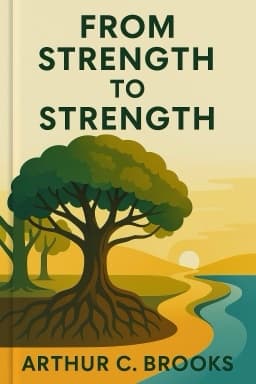
Imagine walking a sunlit path lined with blossoming trees, surrounded by loved ones, carrying the lantern of wisdom. This journey from strength to strength is not only possible but waiting for you. By shifting focus from external success to inner growth, connection, and service, you can transform midlife into a season of flourishing and legacy.
Whether you are just beginning to sense the first signs of change or are deep in transition, the insights from 'The Second Mountain' offer a roadmap to reclaim your life’s meaning and joy. Your best years are not behind you—they are ahead, waiting to be discovered.
References: Insights drawn from the book 'The Second Mountain' by Arthur C. Brooks and supported by scientific studies on intelligence, addiction, relationships, and spirituality. Additional perspectives from reviews and analyses at Medium, The Guardian, Spectrum Magazine, and SoBrief.com. 1 , 2 , 3 , 4
Want to explore more insights from this book?
Read the full book summary