
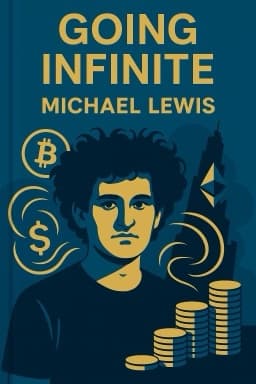
Inside the Mind of a Crypto King: What 'Going Infinite' Reveals About Sam Bankman-Fried
How Michael Lewis Unmasks Genius, Hubris, and the Dark Side of Altruism in Crypto

How Michael Lewis Unmasks Genius, Hubris, and the Dark Side of Altruism in Crypto
In the world of cryptocurrency, few figures have risen—and fallen—as spectacularly as Sam Bankman-Fried. Michael Lewis’s 'Going Infinite' offers readers a rare, intimate look into the mind of this enigmatic figure, tracing his journey from a math-obsessed child to the architect of one of the most dramatic financial collapses of our time. The story begins in the quiet halls of academia, where SBF’s parents, both Stanford law professors, fostered an environment of relentless debate and intellectual rigor. There were no birthday parties or family holidays—just a constant stream of philosophical arguments and logic puzzles. This upbringing shaped SBF’s utilitarian worldview, instilling in him the belief that every action should be measured by its potential to maximize good.
Lewis masterfully captures how SBF’s early fascination with logic and probability led him to Wall Street, where he thrived in the high-pressure world of quantitative trading. At Jane Street, SBF learned that life—and markets—are a series of games, each with hidden rules and unpredictable outcomes. He applied this meta-awareness to every decision, always questioning motives and seeking the highest expected value. But it was in the wild west of crypto that SBF found his true calling. With the launch of Alameda Research and then FTX, he built an empire fueled by innovation, relentless work, and a mission to ‘earn to give’—to amass wealth for the purpose of philanthropy.
The book doesn’t shy away from the contradictions at the heart of SBF’s philosophy. While he recruited a team of effective altruists and preached the gospel of doing good, the culture at FTX was anything but harmonious. Employees worked around the clock, management was chaotic, and ethical lines were often blurred in the pursuit of growth. Lewis draws on vivid, sometimes chilling anecdotes to illustrate how SBF’s single-minded focus on impact led him to rationalize risks that would ultimately prove catastrophic.
As FTX soared to global prominence, attracting billions in trading volume and celebrity endorsements, the cracks began to show. Lewis details the warning signs—risky trades, liquidity crises, and an absence of regulatory oversight—that foreshadowed the collapse. When the end came, it was swift and devastating: billions in customer funds vanished, employees lost their livelihoods, and the crypto industry was shaken to its core.
Yet, 'Going Infinite' is not just a story of downfall. It’s a meditation on the limits of rationality and the dangers of believing that good intentions can justify any means. Lewis challenges readers to question the narratives we build around genius and success, and to ask whether the pursuit of impact can ever truly be separated from the messy realities of human nature.
In the aftermath, as regulators and industry leaders scramble to rebuild trust, Lewis’s book serves as both a warning and a guide. The legacy of SBF and FTX is still being written, but the lessons are clear: brilliance without humility is a recipe for disaster, and the greatest risks are often those we rationalize away. For anyone interested in the intersection of technology, ethics, and ambition, 'Going Infinite' is essential reading—equal parts thriller, cautionary tale, and philosophical inquiry. 1 2 3 4
Want to explore more insights from this book?
Read the full book summary