
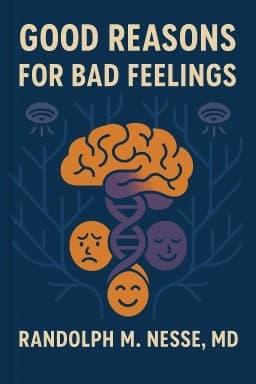
Why Your Brain’s ‘Bad Feelings’ Are Actually Good for You: The Evolutionary Secret Behind Mental Health
Discover the surprising evolutionary reasons why anxiety, depression, and other ‘bad feelings’ are essential signals rather than mere flaws.

For centuries, emotions like anxiety, sadness, and guilt have been labeled as purely negative experiences to be eliminated or suppressed. But what if these feelings are not just unfortunate glitches in our mental software but vital signals crafted by evolution itself? This transformative idea reshapes how we understand mental health and disorders.
Our minds evolved in environments vastly different from today's urban, digital world. This mismatch creates vulnerabilities, as our ancient brains struggle to adapt to modern stressors. For example, the abundance of sugary foods and social media stimuli can overwhelm systems designed for scarcity and direct social interaction.
Scientists have identified six key evolutionary reasons why our minds are vulnerable: mismatch with modern environments, rapid pathogen evolution challenging our immune system, biological constraints limiting perfect design, trade-offs where gains in one area cost another, reproductive priorities favoring gene propagation over individual health, and defensive responses like anxiety that err on the side of caution. These factors combine to explain why mental disorders persist despite natural selection.
Take anxiety, often seen as a crippling disorder. Evolutionary psychiatry reveals it as a smoke detector system—producing many false alarms to avoid rare but catastrophic threats. This perspective normalizes anxiety and guides effective treatments such as exposure therapy, which retrains the brain’s alarm system.
Mood, another key player, regulates motivation by signaling when to persist or give up on goals. Low mood can be an adaptive response to conserve energy when efforts are unlikely to succeed, while persistent dysregulation leads to depression, a serious disorder requiring care.
Social connections profoundly influence mental health. The brain processes social rejection similarly to physical pain, explaining the deep distress of loneliness. Emotions like guilt evolved to maintain cooperation and social bonds, essential for survival in groups.
However, evolutionary trade-offs can lead to severe disorders. Some genes beneficial in moderation cause schizophrenia or bipolar disorder beyond a tipping point. Addiction hijacks reward pathways, illustrating how evolutionary systems can be exploited.
Evolutionary psychiatry offers a unifying framework that integrates biology, psychology, and social science, inspiring new research and compassionate care approaches. By understanding the good reasons behind bad feelings, we can foster hope and healing in mental health.
This evolutionary lens invites us to listen to our emotions with empathy and curiosity, embracing their messages rather than fearing them. It promises a future where mental health care is more insightful, effective, and humane.
Want to explore more insights from this book?
Read the full book summary