
Unlocking the Secret Sauce: Why Most Strategies Fail and How to Fix Yours Now
Discover the hidden pitfalls of bad strategy and learn the powerful framework that separates winners from losers in business and beyond.

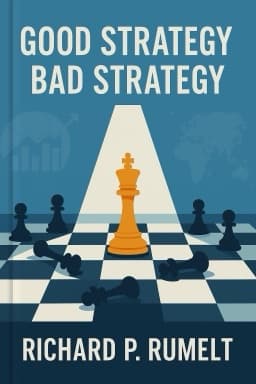
Strategy is often talked about but rarely understood. Many leaders confuse lofty goals, inspirational visions, and buzzword-filled presentations with actual strategy. Yet, as Richard Rumelt reveals in his seminal work, Good Strategy Bad Strategy, true strategy is a rare and powerful tool that demands clarity, focus, and courage.
At the heart of bad strategy lies a dangerous cocktail of fluff, vague objectives, and the refusal to make hard choices. Organizations often fall into the trap of mistaking goals for strategy—setting ambitious targets without diagnosing the real challenges or outlining coherent actions. This leads to wasted resources, confusion, and eventual failure.
Rumelt’s framework introduces the concept of the strategy kernel: a triad of diagnosis, guiding policy, and coherent actions. Diagnosis involves cutting through complexity to identify the critical obstacles. The guiding policy sets a clear approach to tackle these challenges, while coherent actions are the concrete steps aligned to this policy. This structure transforms strategy from empty rhetoric into a living blueprint for success.
Consider the turnaround of a struggling tech giant in the late 1990s. By radically simplifying its product line and focusing resources on a few key offerings, it reversed its decline and regained market leadership. This example illustrates the power of focus and leverage—concentrating effort on pivotal objectives to create outsized impact.
Moreover, strategy requires resisting the natural human and organizational tendencies to avoid conflict and make everyone happy. The political and emotional difficulty of saying no results in vague, compromised strategies that satisfy no one. Understanding phenomena like Condorcet’s paradox sheds light on why groups struggle to reach clear strategic decisions, emphasizing the need for strong leadership.
True strategic thinking also embraces a scientific mindset, treating strategy as a hypothesis to be tested and refined. Independent judgment and skepticism guard against groupthink and hype, enabling leaders to adapt and learn in dynamic environments.
By mastering these principles, leaders can craft strategies that not only survive but thrive amid uncertainty and change, capturing competitive advantage and driving lasting success.
Ready to transform your approach? Let’s dive deeper into the elements that make strategy work and how you can apply them today.
Sources: YouExec summary 1 , TheRightQuestions review 2 , Amazon customer insights 4
Want to explore more insights from this book?
Read the full book summary