
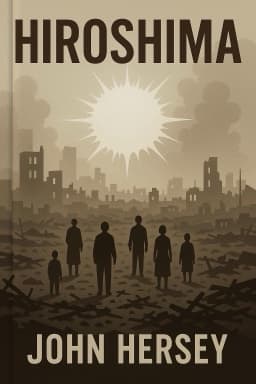
6 Lives, 1 Morning: The Untold Human Stories of Hiroshima
Discover the real people behind the headlines and how their ordinary lives were changed forever in a single moment.

Discover the real people behind the headlines and how their ordinary lives were changed forever in a single moment.
On August 6th, 1945, Hiroshima was a city like any other, filled with the rhythms of daily life. Children went to school, workers headed to their jobs, and families prepared for another day. Yet, in a flash, everything changed. John Hersey’s ‘Hiroshima’ brings us into the lives of six ordinary people who, by chance and circumstance, became witnesses to one of history’s most cataclysmic moments. Their stories—woven together with compassion and clarity—reveal not just the horror of the atomic bomb, but the resilience, courage, and empathy that emerged from its aftermath.
Hersey’s account begins in the mundane: a clerk tidying her home, doctors reading newspapers, a priest at prayer. This ordinariness is what makes the sudden intrusion of violence so jarring. When the bomb explodes, these individuals are thrown into chaos—buried under debris, flung across rooms, or blinded by the light. Yet, it is in the aftermath that their true character emerges. Despite their own injuries, many survivors instinctively help others, carrying the wounded, sharing water, and comforting children. The city’s rivers, once symbols of tranquility, become sites of both refuge and tragedy as people flock to them for relief.
What Hersey captures so powerfully is the randomness of survival. Some lived because they took a different streetcar, or paused to tie a shoe. Others lost everything in an instant. The narrative doesn’t dwell on military strategy or political calculations; instead, it asks us to consider the fate of individuals—each with their own fears, hopes, and dreams. As the city is transformed into a landscape of suffering, the survivors’ stories become a testament to the endurance of the human spirit. The silence after the blast, the stoic suffering, and the countless small acts of kindness all serve to remind us that history is not made by events alone, but by the people who live through them.
In today’s world, where headlines often reduce tragedies to numbers and statistics, ‘Hiroshima’ stands out for its unwavering focus on the personal. The stories of these six survivors continue to resonate, reminding us that every historical event is also a collection of individual lives, forever changed. Their voices, preserved through Hersey’s reporting, challenge us to remember, to empathize, and to seek understanding in the face of unimaginable loss.
For a deeper exploration of these themes and the broader impact of Hersey’s work, see analyses on SparkNotes and The National WWII Museum. 1 2
Want to explore more insights from this book?
Read the full book summary