
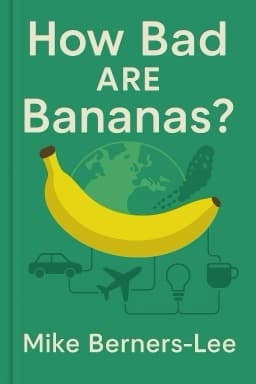
How Bad Are Bananas? The Shocking Truth About Your Everyday Carbon Footprint
Unveiling the Invisible Weight You Carry Every Day and How to Lighten It

Carbon footprints are often talked about but rarely fully understood. Mike Berners-Lee’s book How Bad Are Bananas? The Carbon Footprint of Everything cuts through the confusion by meticulously calculating the carbon emissions of everyday items and activities. The book begins with the simple question: how bad are bananas? Surprisingly, bananas have a relatively low carbon footprint despite being imported globally. This sets the stage for a broader exploration of carbon footprints, which Berners-Lee defines as the total climate impact of all greenhouse gases expressed as carbon dioxide equivalent (CO2e). This includes not only carbon dioxide but also methane, nitrous oxide, and others, each weighted by their warming potential.
One of the book’s fundamental lessons is that carbon footprints are complex and often hidden. For instance, the carbon cost of a plastic toy includes not just manufacturing emissions but also the emissions embedded in the supply chain, such as mining iron for steel used in the factory’s office supplies. Aviation emissions are particularly complex because emissions released at high altitudes have nearly twice the warming effect compared to those at ground level, leading to a multiplier of 1.9 in footprint calculations.
Berners-Lee also debunks common myths about low-impact actions. Sending a text message emits about 0.014 grams of CO2e, while a plastic bag’s footprint is about 10 grams, tiny compared to the carbon cost of the food they carry. Spam emails, although comprising 78% of email volume, account for 22% of email-related carbon emissions due to the energy used in filtering and deleting them. These insights remind us to focus on big-impact activities rather than minor ones.
The book dives into travel, revealing that cycling’s carbon footprint depends heavily on the food consumed for energy. Cycling powered by bananas emits about 65 grams CO2e per mile, but powered by cheeseburgers, it’s four times higher. Car manufacturing accounts for about 40% of a car’s total carbon footprint, emphasizing the value of maintaining and extending the life of vehicles. Flying remains one of the highest carbon activities, with a single round trip across the Atlantic emitting several tons of CO2e.
Food choices are another major theme. Plant-based foods like bananas have low footprints, while beef and dairy products are carbon-heavy due to methane emissions from ruminant animals and land use. Air-freighted produce, such as asparagus from Peru, can have a footprint exceeding 3.5 kg CO2e per pack, highlighting the importance of choosing seasonal and local foods.
Berners-Lee also discusses the broader societal and global impacts of carbon emissions, including deforestation’s role in releasing stored carbon and the human costs linked to climate change. The book stresses that individual actions must be complemented by systemic change—through policies, infrastructure, and collective efforts—to achieve meaningful emissions reductions.
Practical advice includes prioritizing cost-effective measures like attic insulation, understanding the rebound effect where efficiency gains may lead to increased consumption, and focusing on high-impact lifestyle changes such as reducing air travel and driving less. The book concludes with a hopeful message about the power of small wins, simplicity, and collective responsibility to drive sustainable transformation.
Mike Berners-Lee’s How Bad Are Bananas? is both a wake-up call and a guidebook, blending scientific detail with accessible storytelling to empower readers to understand and reduce their carbon footprints. It is a must-read for anyone seeking to navigate the complexities of climate impact with clarity and purpose.
For further reading and reviews, see Want to explore more insights from this book?