
Why Everything You Think About Emotions Is Wrong: The Shocking Science Behind Your Feelings
Discover the hidden truth about emotions that will change how you see yourself—and everyone else.

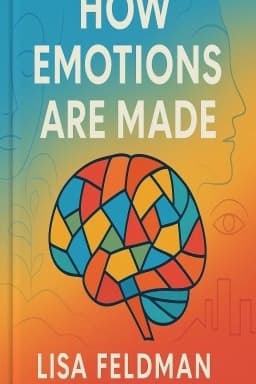
For decades, we’ve been told that emotions are universal, hardwired reactions—anger looks the same in Tokyo as it does in Toronto, and happiness lights up the same brain circuits in everyone. But what if this story is wrong? Neuroscientist Lisa Feldman Barrett, in her bestselling book How Emotions Are Made, reveals a radically different truth: emotions are not built-in, but made—constructed by your brain, moment by moment, using your body’s signals, your memories, and the concepts you’ve learned from your culture and language.
Imagine you’re at a crowded airport. A stranger bumps into you. Is your racing heart a sign of anger, fear, or excitement? The answer depends not on some ancient emotional circuit, but on how your brain interprets the bodily sensations you feel, drawing on your past experiences and the words you know. This process, called interoception, is the foundation of every emotion. Your brain is constantly reading your heartbeat, breathing, and other internal signals, then predicting what they mean in context.
Barrett’s research, and a wave of new science, shows there are no universal emotion fingerprints. Meta-analyses of hundreds of studies have failed to find unique facial or bodily markers for emotions like anger, sadness, or joy. Instead, emotions vary wildly between people and cultures. What’s called 'anger' in one place might be 'shame' or 'disappointment' elsewhere. Even brain scans reveal no single 'fear center' or 'happiness circuit.' Instead, your brain constructs each emotion anew, like a jazz musician riffing on a theme.
Words and concepts are the architects of emotion. Children who learn more emotion words grow up to be adults who can better distinguish and manage their feelings—a skill called emotional granularity. The more precisely you can label what you feel, the more options you have for responding. This is not just self-help fluff: studies show that people with higher emotional granularity are less likely to suffer from depression, anxiety, or chronic stress.
But why does this matter? Understanding that emotions are constructed can transform your life. In medicine, it means doctors must look beyond stereotypes—women and minorities, for example, are often misdiagnosed because their emotional expressions are misunderstood. In law, it means we can’t judge guilt or innocence by a defendant’s face. In everyday life, it means you can learn to shape your emotions by expanding your vocabulary, tuning in to your body, and questioning your assumptions.
Perhaps most empowering, Barrett’s theory shows you can become the architect of your own emotional life. By learning new emotion concepts, practicing self-awareness, and treating yourself with compassion, you can literally change how you feel—and how you see the world.
Ready to stop being a passive victim of your feelings? Dive deeper into the science of constructed emotion, and discover how to rewrite your emotional story—one moment at a time.
Want to explore more insights from this book?
Read the full book summary