
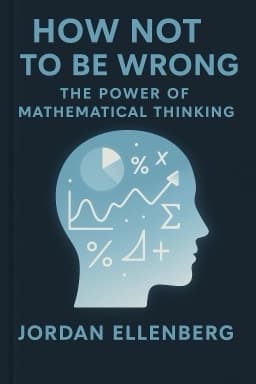
How a Math Book Could Save You From Bad Decisions (And Maybe Even Help You Win at Life)
Explore how mathematical thinking can improve your life choices and help you avoid costly errors.

Explore how mathematical thinking can improve your life choices and help you avoid costly errors
We all want to make better choices—whether about money, health, or relationships—but the path is often clouded by uncertainty and misinformation. Jordan Ellenberg’s How Not to Be Wrong offers a fresh perspective: math is not just abstract theory but a practical tool to navigate life’s complexities.
One key insight is the concept of expected value, which helps us weigh risks and rewards rationally. For example, when deciding whether to buy insurance or play the lottery, understanding expected value clarifies when these choices make sense and when they don’t. Ellenberg also highlights how human psychology often deviates from pure mathematical rationality, explaining why people take risks that seem irrational on paper.
The book also warns against common cognitive traps like survivorship bias and false linearity, which can lead to costly mistakes in investments or health decisions. By learning to recognize these biases, you become better equipped to question assumptions and seek fuller information.
Ultimately, How Not to Be Wrong is a call to embrace mathematical thinking as a way to improve your judgment and live a wiser, more informed life. Whether you’re managing your finances or simply trying to understand the news, the lessons in this book can help you avoid error and seize opportunity.
Sources: [[0]](#__0), [[1]](#__1), [[3]](#__3)
Want to explore more insights from this book?
Read the full book summary