
The Math Behind Why You Should Always Question What You Think You Know
A deep dive into the philosophical lessons from math that teach us humility and curiosity.

A deep dive into the philosophical lessons from math that teach us humility and curiosity
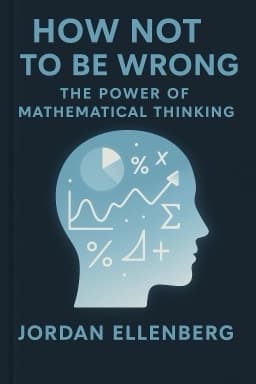
Mathematics is often hailed as the language of truth, but beneath its elegant formulas lies a humbling revelation: there are limits to what can be proven or known. Jordan Ellenberg’s How Not to Be Wrong invites us to explore these boundaries and the lessons they offer for thinking wisely.
One of the most striking ideas comes from Gödel’s incompleteness theorems, which show that no formal mathematical system can prove all truths within its own rules. This means there will always be questions that elude definitive answers, reminding us that certainty is not absolute.
Ellenberg reflects on how mathematics is both rigorous and creative, a human endeavor balancing logic with intuition. This perspective encourages us to embrace uncertainty and remain curious rather than cling to false certainties.
These philosophical insights extend beyond math, offering guidance for everyday life. They teach us to question assumptions, remain open to new information, and accept that some mysteries may never be fully solved.
In a world that often demands quick answers, the lessons from How Not to Be Wrong inspire a thoughtful, humble approach to knowledge and decision-making.
Sources: [[1]](#__1), [[2]](#__2)
Want to explore more insights from this book?
Read the full book summary