
The Secret Math Weapons That Will Help You Win Arguments and Make Better Decisions
Equip yourself with mathematical insights to navigate uncertainty and outsmart misinformation.

Equip yourself with mathematical insights to navigate uncertainty and outsmart misinformation
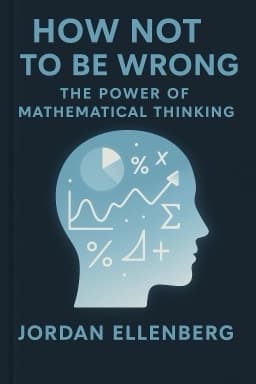
Every day we face a barrage of information—from news headlines to social media posts—often filled with numbers and statistics that shape our opinions and decisions. But how many of us have the tools to critically evaluate this data? Jordan Ellenberg’s How Not to Be Wrong offers a treasure trove of mathematical insights that empower you to think more clearly and argue more persuasively.
One of the fundamental lessons is to always question assumptions. Whether analyzing political statistics or business reports, assumptions shape conclusions. The smartest thinkers ask, "What assumptions underlie this data?" This habit helps uncover hidden biases and avoid jumping to wrong conclusions.
The book also teaches about variability and sample size. Small samples are prone to extreme results due to chance, so it’s vital to consider whether data comes from a sufficiently large and representative sample before trusting it.
Regression to the mean is another powerful concept that explains why exceptional performances are often followed by more average ones. This helps temper expectations and avoid overreacting to outliers.
By mastering these mathematical principles, you gain a secret weapon to dissect arguments, spot misleading statistics, and make decisions grounded in reason rather than emotion or misinformation.
Whether you’re negotiating, debating, or simply trying to understand the world better, How Not to Be Wrong equips you with the critical thinking skills needed to succeed.
Sources: [[1]](#__1), [[2]](#__2), [[3]](#__3)
Want to explore more insights from this book?
Read the full book summary