
Unlocking the Hidden Math Behind Everyday Decisions: How Not to Be Wrong Will Change Your Thinking Forever
Discover how mathematical thinking can sharpen your reasoning and help you avoid common errors in everyday life.

How Not to Be Wrong Will Change Your Thinking Forever
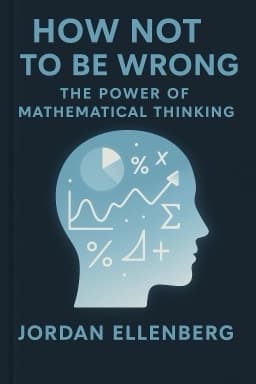
Imagine a world where every decision you make is backed by a clearer understanding of the hidden patterns and pitfalls lurking beneath the surface. This is the promise of Jordan Ellenberg’s book, How Not to Be Wrong, a masterful exploration of how mathematical thinking can transform our approach to problems big and small.
At its core, the book reveals that mathematics is an extension of common sense, a toolset that helps us avoid the traps of cognitive biases and misleading data. One of the most striking examples is the story of WWII planes returning from battle. Initially, analysts thought to reinforce the parts of the planes that showed the most bullet holes. But by applying mathematical reasoning, they realized the missing planes—those that didn’t return—were hit where damage was most critical, such as the engines. This insight, born from understanding survivorship bias, saved lives and demonstrated the power of looking beyond the obvious.
Throughout the book, Ellenberg tackles the dangers of false linearity—the assumption that trends continue in straight lines. For example, projecting obesity rates or missile trajectories as straight lines leads to absurd conclusions. Instead, understanding curves and limits allows for more accurate predictions and wiser decisions.
The book also delves into the pitfalls of small sample sizes, explaining why early-season sports statistics or small school test scores can wildly fluctuate due to chance rather than true skill or quality. This variability is explained by the Law of Large Numbers and reminds us to be cautious when interpreting data from limited samples.
Another powerful lesson is the subtle use and misuse of statistics in politics and media. Percentages of net changes can be technically correct but misleading without context. Ellenberg teaches readers to critically evaluate such claims and understand the underlying math to avoid being swayed by partisan spin.
As the narrative progresses, the book explores concepts like expected value, helping readers grasp how to make rational decisions under uncertainty, balancing mathematical expectation with human psychology and risk preferences.
Regression to the mean is another gem, revealing why extreme performances tend to be followed by more average ones, a principle that applies to everything from sports to heredity.
Finally, Ellenberg reflects on the philosophical foundations of mathematics, highlighting its limits as shown by Gödel’s incompleteness theorems and celebrating math as a human, creative endeavor that balances rigor and intuition.
In essence, How Not to Be Wrong is an invitation to think deeply, question boldly, and embrace the power of mathematical thinking to navigate a world full of uncertainty and complexity. Whether you’re a math enthusiast or a curious reader, this book offers profound insights that will sharpen your mind and enrich your life.
For anyone looking to improve their reasoning and decision-making skills, this book is a must-read treasure trove of wisdom and practical advice. Dive in and discover how math can help you not just calculate, but truly understand the world.
Sources: [[0]](#__0), [[1]](#__1), [[2]](#__2), [[3]](#__3)
Want to explore more insights from this book?
Read the full book summary