
Why You’re Probably Thinking Wrong: The Mathematical Truths That Will Make You Smarter
Uncover the hidden errors in your thinking and learn how math can help you avoid them.

The Mathematical Truths That Will Make You Smarter
Have you ever been sure about something, only to find out you were completely wrong? It turns out, your brain is wired to take shortcuts that sometimes lead us astray. The good news is that mathematics offers a way to see through these illusions and sharpen our reasoning.
One of the most pervasive errors is survivorship bias—the tendency to focus on winners and ignore those who fail. This bias was famously exposed in the analysis of WWII aircraft damage, where focusing only on planes that returned led to incorrect armor placement. Recognizing this bias can help us make better judgments in investing, business, and everyday life.
Another common trap is false linearity, where we assume trends will continue straight and steady. Ellenberg shows how this assumption can lead to absurd predictions, like everyone eventually becoming obese or missiles flying forever. Understanding the true curves and limits in data helps us avoid these mistakes.
Small sample sizes also deceive us by producing extreme results that don’t reflect reality. The Law of Large Numbers explains why bigger samples give more reliable averages, teaching us to be cautious about early or limited data.
Politics and media often misuse statistics, presenting technically correct numbers in misleading ways. Ellenberg encourages critical thinking and mathematical literacy to see beyond spin and understand the real story behind the numbers.
Finally, the book explores regression to the mean, a principle reminding us that extraordinary success or failure tends to be followed by more average outcomes. This insight helps temper expectations and interpret performance more realistically.
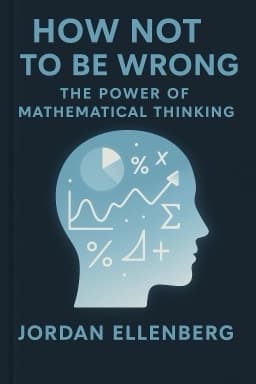
By learning these mathematical truths, you can start recognizing when your thinking is going off course and steer yourself back toward clarity and accuracy. How Not to Be Wrong is a roadmap to smarter thinking, empowering you to question assumptions and embrace uncertainty with confidence.
If you want to understand why you might be thinking wrong and how to fix it, this book is an eye-opening guide that will change your perspective forever.
Sources: [[0]](#__0), [[2]](#__2), [[3]](#__3)
Want to explore more insights from this book?
Read the full book summary