
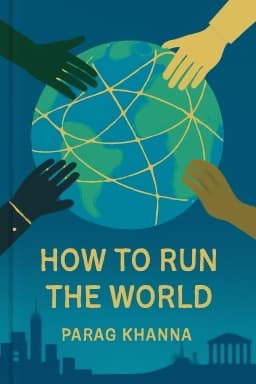
Why ‘How to Run the World’ Could Change How You See Global Power (And Your Place In It)
A Deep Dive into Parag Khanna’s Vision for a New Global Renaissance

A Deep Dive into Parag Khanna’s Vision for a New Global Renaissance
Imagine waking up in a world where the headlines are no longer dominated by presidents or prime ministers, but by coalitions of cities, tech titans, grassroots activists, and even ordinary citizens. This is the world Parag Khanna invites us to see in his ambitious book, How to Run the World. The book is a call to action, a roadmap, and a meditation on the future of power—a future that is already arriving, whether we’re ready or not.
Khanna’s core thesis is that the 20th-century order—dominated by superpowers, rigid alliances, and formal treaties—has fractured. In its place, a neo-medieval world is emerging, reminiscent of an era where power was diffuse, alliances were fluid, and the map was a patchwork of overlapping authorities. Today, the actors are even more varied: multinational corporations with budgets larger than countries, NGOs that deliver health care and education in places where governments can’t, and cities that act as engines of innovation and diplomacy.
One of the book’s most compelling insights is the rise of 'mega-diplomacy.' In Khanna’s world, diplomacy is no longer the exclusive domain of foreign ministries. Instead, it’s a 'jazzy dance,' a series of improvisations and coalitions that get things done when old institutions stall. Think of how cities like New York or Shanghai lead on climate change, or how tech companies and humanitarian NGOs team up to deliver aid in crisis zones. These coalitions are messy, but they are effective—and they are redefining what it means to solve global problems.
Khanna doesn’t shy away from the chaos. He acknowledges that the world is full of failed states, resource conflicts, and humanitarian disasters. But he sees opportunity in adversity. Crises, he argues, are catalysts for new forms of cooperation. When governments falter, NGOs, businesses, and communities step in—not just to fill gaps, but to experiment, learn, and adapt. The book is full of examples: from disaster relief powered by digital volunteers to peace deals brokered by faith leaders and local councils.
Perhaps the most hopeful message in How to Run the World is that anyone can be a diplomat now. The tools of change—networking, negotiation, coalition-building—are in everyone’s hands. Technology amplifies voices, connects movements, and holds power to account. Khanna points to youth-led climate strikes, viral transparency campaigns, and the rapid rise of new political movements as proof that the Renaissance is not just for elites. It’s for all of us.
So why does this matter? Because the problems we face—pandemics, climate change, digital security—are too big for any one actor. The future belongs to those who can build bridges, adapt quickly, and turn crises into opportunities. Khanna’s book is both a warning and a celebration: a warning that old solutions will not work, but a celebration of the creativity and resilience that define our age.
For anyone seeking to understand the world’s new operating system, or to play a part in its ongoing story, How to Run the World is essential reading. It is a book that challenges, inspires, and ultimately empowers. The Renaissance, Khanna reminds us, is not a moment in history—it is a process, one that each of us can help shape, stroke by stroke, coalition by coalition.
Want to explore more insights from this book?
Read the full book summary