
The Hidden Laws of Computational Design: How Machines Think Differently and Why It Matters to You
Dive into the fundamental principles that govern machine intelligence and their profound impact on design and society.

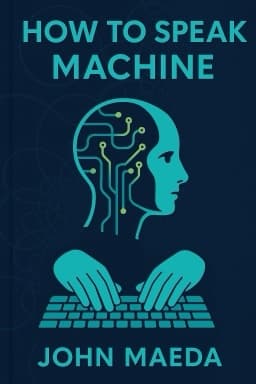
Machines do not think like humans. They obey a different set of laws—laws that unlock their extraordinary capabilities but also create challenges and responsibilities for us. In How to Speak Machine, John Maeda reveals these hidden laws of computational design, inviting us to rethink our relationship with technology.
At the core lies the concept of loops and recursion. Unlike human tasks that tire and lose precision, machines execute infinite loops flawlessly. Recursion, where a function calls itself, creates elegant infinite structures akin to Russian nesting dolls or the Möbius strip. These ideas are not abstract; they underpin everything from simple programs to complex AI systems.
Exponential growth is another fundamental law. The lily pad doubling riddle exemplifies how small changes compound rapidly, a principle driving Moore’s law and the explosive expansion of computational power. Nested loops add dimensions, transforming linear processes into multi-dimensional spaces. This scaling challenges our intuition and calls for new ways to think and design.
Maeda also explores how machines begin to mimic life through responsiveness and adaptability. Early AI chatbots created illusions of understanding through scripted responses, while modern neural networks learn from data, powered by GPUs. This evolution blurs the boundary between lifeless code and lifelike behavior, raising questions about what it means to be alive.
Design in the computational age is inherently iterative. Software is never complete; it evolves through continuous feedback and improvement. The shift from minimum viable products to minimum viable lovable products emphasizes emotional connection, vital in subscription models. This approach demands agility, empathy, and cross-disciplinary collaboration.
Instrumentation and telemetry allow machines to listen and learn, collecting vast data streams that inform personalization and improvement. Yet, this power requires careful ethical consideration, balancing personalization with privacy. Data science integrates big quantitative data with thick qualitative insights to create meaningful understanding.
Socially, Maeda warns of the dangers of bias and exclusion encoded in AI and tech culture. The book advocates for open source transparency and human-centered design to foster equity and inclusion. Ethical stewardship and empathy are paramount in guiding technology’s trajectory.
Understanding these laws empowers us to speak machine fluently, blending technical mastery with cultural and ethical insight. This fluency is essential for shaping a future where technology enhances human values rather than undermines them.
As AI and computational design continue to evolve, reflecting on these foundational laws helps us navigate complexity with wisdom and creativity. The journey is ongoing, and the stakes have never been higher.
Want to explore more insights from this book?
Read the full book summary