
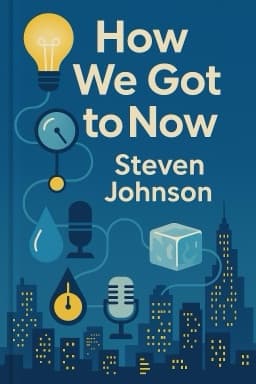
Unveiling the Hidden Forces Behind Everyday Innovations: How Glass, Ice, and Sound Shaped Our World
Discover the surprising stories behind six transformative inventions that quietly revolutionized human civilization.

How Glass, Ice, and Sound Shaped Our World
Innovation is often perceived as sudden flashes of genius, but in reality, it is a slow, interconnected dance of ideas, materials, and societal needs. This narrative is beautifully illustrated in the journey of six transformative inventions that have quietly revolutionized human civilization. Let’s embark on a voyage through time to understand how seemingly simple discoveries—glass, ice, sound, sanitation, timekeeping, and artificial light—have shaped the world we know today.
The Magic of Glass: Seeing Beyond the Surface
Imagine millions of years ago, a desert where sand melts under a superheated sky, forming natural glass. This rare substance fascinated early humans, but it was the ingenuity of Roman and Venetian glassmakers that truly unlocked its potential. The creation of cristallo, a crystal-clear glass, was more than an artistic triumph; it was a scientific revolution. This clarity enabled the development of optical instruments like microscopes and telescopes, expanding human vision into the microscopic and cosmic realms.
Cold Revolution: From Ice Trade to Air Conditioning
Transporting ice across oceans seems trivial today, but in the 19th century, it was a daring enterprise. Early shipments melted or were ignored by tropical consumers unfamiliar with ice. Through innovation—like insulating ice blocks with sawdust—and persistence, ice became a global commodity. Artificial refrigeration soon followed, transforming medicine, food preservation, and comfort. Air conditioning reshaped demographics, enabling population booms in previously inhospitable regions and altering political landscapes.
The Soundscape of Progress: Capturing and Connecting Voices
Sound, once ephemeral, began its journey toward permanence with devices that recorded waveforms visually but could not play them back. The invention of the telephone electrified communication, while radio waves brought music and voices into homes, breaking social barriers. Secret wartime projects digitized sound for secure communication, laying the foundation for today’s digital media landscape.
Engineering Clean Water and Sanitation: Foundations of Urban Health
Filthy streets and deadly cholera outbreaks once plagued growing cities. Ingenious projects like raising entire city blocks in Chicago to install sewers without disrupting life exemplify human determination to create healthier environments. The discovery that cholera spread through contaminated water shifted public health paradigms, leading to chlorination and widespread sanitation. Hygiene products and media campaigns further embedded cleanliness into culture.
Mastering Time: The Clockwork of Civilization
Timekeeping evolved from Galileo’s observation of a swinging lamp’s steady rhythm to atomic clocks measuring vibrations of cesium atoms. The standardization of time zones, driven by railroads, synchronized societies and enabled industrial growth. Today’s GPS systems rely on atomic precision to guide everything from navigation to telecommunications.
Illuminating the World: The Journey of Artificial Light
From smoky tallow candles to the bright glow of whale oil lamps, artificial light extended human activity into the night. Edison’s choice of carbonized bamboo for filaments made electric bulbs practical, revolutionizing urban life. Neon lights transformed cityscapes into vibrant nocturnal playgrounds, while lasers today power scientific research and communication.
These six innovations, woven together, reveal a complex tapestry of human ingenuity and adaptation. Each breakthrough built upon previous discoveries and responded to societal needs, demonstrating that innovation is a collective, networked process. As we look to the future, understanding these histories empowers us to navigate the challenges and possibilities ahead.
Want to explore more insights from this book?
Read the full book summary