
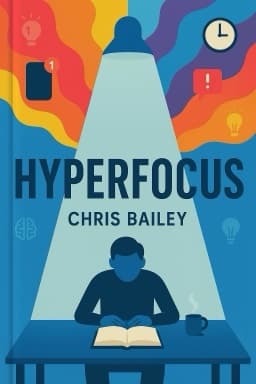
Unlocking the Hidden Power of Attention: The Hyperfocus Blueprint
How mastering your attention can transform your work, creativity, and life

How mastering your attention can transform your work, creativity, and life
In an age where distractions are just a click away and our to-do lists seem endless, it's easy to feel like we're constantly busy yet rarely productive. Chris Bailey’s Hyperfocus offers a refreshing antidote: the idea that attention—not time or willpower—is the true currency of a meaningful, accomplished life. Through research, personal experiments, and practical wisdom, Bailey guides us to reclaim our focus and, in turn, our fulfillment.
Imagine your brain as a cozy workspace with only four seats. Each seat can hold one thought, task, or worry. When you try to juggle too much, something inevitably falls off. This is the reality of our working memory—scientifically proven to handle just four 'chunks' at once. The implication? What you choose to focus on matters more than how much you try to do. The book introduces two main modes of attention: hyperfocus and scatterfocus.
Hyperfocus is the state of deep, undistracted concentration on a single meaningful task. It’s where productivity soars, creative work flourishes, and time seems to disappear. Bailey outlines a four-stage process to enter hyperfocus: set a clear intention, eliminate distractions in advance, focus deeply for a set period, and gently refocus when your mind inevitably wanders. He shares that even seasoned professionals lose focus every 40 seconds on average when working on a computer—unless they take steps to block interruptions.
But what about those moments when your mind drifts off during a walk, a shower, or a boring meeting? Bailey calls this scatterfocus, and argues it’s not wasted time. In fact, intentional mind-wandering is essential for creative breakthroughs, long-term planning, and problem-solving. The 'incubation effect'—where stepping away from a problem leads to sudden insight—is backed by neuroscience. The trick is to balance periods of deep hyperfocus with scheduled scatterfocus, letting your mind roam and connect ideas in the background.
To make these states a habit, Bailey recommends the Rule of 3: each morning, identify three key tasks that, if completed, will make your day a success. This simple ritual cuts through overwhelm and aligns your actions with your priorities. He also advocates for environmental tweaks—using website blockers, silencing notifications, and creating physical cues for focus. Even small changes, like putting your phone out of sight or having a device-free dinner, can dramatically improve your attention and relationships.
One of the book’s most powerful insights is that most distractions are self-inflicted. We interrupt ourselves as often as others do, often out of boredom or habit. The solution is to design your environment and routines so that focus becomes the default, not the exception. Bailey’s tips are practical and science-backed, from batching email checks to using timers for deep work blocks.
Hyperfocus isn’t about perfection—it’s about progress. Some days, focus will come easily; other days, you’ll need to shrink your intervals and embrace imperfection. The key is to keep practicing, balancing intense periods of focus with intentional breaks for creativity and rest. Over time, you’ll build a life where attention flows naturally toward what matters most, both at work and at home.
In conclusion, Hyperfocus is more than a productivity guide—it’s a blueprint for designing a life of intention, creativity, and deep satisfaction. By mastering your attention, you can unlock your best work, your most creative ideas, and your most meaningful relationships.
Want to explore more insights from this book?
Read the full book summary