
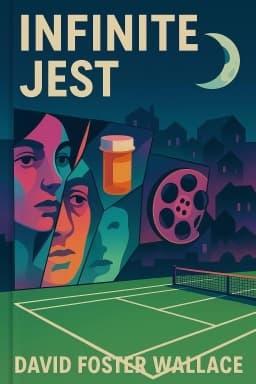
10 Mind-Blowing Secrets Behind Infinite Jest You Never Noticed
Unlocking the layers, codes, and mysteries that make Infinite Jest a literary puzzle for the ages.

If you thought Infinite Jest was just a story about addiction and tennis, think again. David Foster Wallace’s masterpiece is a puzzle box of hidden meanings, literary tricks, and mysteries that have kept fans and scholars debating for decades. In this deep dive, we’ll explore the secrets that make Infinite Jest a never-ending source of fascination.
1. The Footnotes Within Footnotes
The book’s legendary footnotes aren’t just a quirky style—they’re a narrative device that mirrors the way addiction and obsession spiral out of control. Some footnotes even reference other footnotes, creating a sense of infinite recursion.
2. The Missing Ending
Did you know the book’s ending is actually at the beginning? Wallace crafts a circular narrative, forcing readers to piece together the story by flipping back and forth. This mirrors the experience of addiction: no clear start or finish, just endless cycles. 1
3. Hidden Codes and Wordplay
From character names to acronyms, Wallace packs the text with hidden jokes and references. The Entertainment, a film so addictive it destroys viewers, is itself a commentary on the novel’s own addictive qualities. 3
4. The Tennis Court as a Metaphor
Tennis isn’t just a sport here—it’s a metaphor for consciousness, competition, and the boundaries of self. The geometry of the court reflects the structure of the novel and the mental states of its characters.
5. Recurring Motifs: Mirrors and Doubles
Mirrors, twins, and doubles appear throughout, hinting at the fractured identities of the characters and the recursive nature of the narrative. 2
6. Pop Culture Easter Eggs
Wallace weaves in sly references to pop culture, philosophy, and other literature—rewarding readers who pay close attention. There are even nods to Hamlet, reflecting the tragic and comedic duality of the story. 1
7. The Structure of Addiction
The book’s nonlinear, fragmented structure mimics the experience of addiction—chaotic, repetitive, and disorienting. The reader is forced to experience the same confusion and longing as the characters.
8. The Infinite Jest Film
The mysterious film at the heart of the story is never fully described, leaving its true nature open to interpretation. Is it a metaphor for the novel itself, or for any obsession that consumes us? 4
9. Multiple Narrators and Perspectives
The shifting perspectives challenge readers to question reality and truth—mirroring the uncertainty faced by those struggling with addiction and identity. 2
10. The Ultimate Literary Challenge
Wallace designed Infinite Jest to be reread, discussed, and debated—an infinite loop of interpretation. The more you look, the more you find. 1
Infinite Jest isn’t just a book—it’s a literary adventure, a puzzle, and a mirror for our own obsessions. Dive in, and you’ll never read the same way again.
Want to explore more insights from this book?
Read the full book summary