
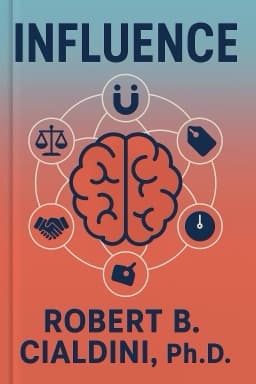
Unlocking the Secrets of Influence: How to Say NO to Manipulation and YES to Power
Discover the hidden forces shaping your decisions and learn how to master the art of influence ethically.

Every day, countless subtle forces shape our decisions, often without our conscious awareness. From the moment we wake up to the time we rest, we are bombarded with requests, suggestions, and social cues that nudge us toward certain behaviors. But what if you could see through these invisible currents? What if you understood the psychological levers that make people say "yes" so often? This is the promise of Robert Cialdini’s groundbreaking work, Influence: The Psychology of Persuasion.
At the core of this book lie six principles that govern human compliance: reciprocation, commitment and consistency, social proof, authority, liking, and scarcity. These principles are not just abstract theories; they manifest in everyday situations, from a simple favor to complex social dynamics.
Reciprocation is the ancient social rule that compels us to repay what others give us. Imagine receiving an unsolicited gift in the mail—a small token from a charity or a free sample from a company. Suddenly, you feel an urge to return the favor, often by donating money or making a purchase. This automatic sense of indebtedness is so powerful that it can override our logical assessment of the situation. For example, a study showed that people who were given a free soft drink by a stranger bought twice as many raffle tickets from that person, even if they didn’t particularly like them. This principle is the foundation of many marketing and sales strategies, but it can also trap us into obligations we never intended to accept.
Commitment and consistency drive us to align our actions with our prior decisions and beliefs. Once we say "yes" to a small request, we are far more likely to agree to a larger one later. This is known as the foot-in-the-door technique. For instance, someone who agrees to sign a petition supporting a cause is more likely to later donate money to that cause. This principle taps into our desire to appear rational and reliable, but it can also lead us to make choices that no longer serve our best interests, simply to avoid cognitive dissonance.
Social proof guides us by showing what others are doing, especially in ambiguous situations. When we see a crowd laughing at a TV show because of canned laughter, we are more likely to find it funny ourselves. In emergencies, however, social proof can fail—leading to the bystander effect, where everyone waits for someone else to act. Advertisers exploit social proof by displaying customer testimonials and popularity metrics, creating a bandwagon effect that encourages us to join the crowd.
Authority wields silent power through titles, uniforms, and status symbols. People instinctively obey doctors, police officers, and business executives, often without questioning their directives. This obedience can be beneficial, ensuring social order, but it can also be dangerous when authority is abused or false. Classic experiments have shown that people will follow harmful orders from perceived authority figures, underscoring the need for critical thinking.
Scarcity intensifies desire by limiting availability. When something is rare or threatened, we want it more. This principle explains why limited-time offers and exclusive editions drive sales. Scarcity triggers psychological reactance—the urge to reclaim freedoms when they are restricted. This reaction is strongest in adolescence but persists throughout life, influencing our decisions in profound ways.
Understanding these principles is not just about recognizing how others influence us; it is about reclaiming control. Awareness reduces our vulnerability to manipulation and allows us to use persuasion ethically and effectively. As Alfred North Whitehead said, "Civilization advances by extending the number of operations we can perform without thinking about them." But the power lies in knowing when to think.
By mastering the art of influence, you can improve your relationships, negotiate better, and lead with integrity. This journey begins with knowledge, continues with mindfulness, and culminates in empowerment.
Ready to dive deeper? Let’s explore each principle, enriched with fascinating experiments and real-world examples that illuminate the subtle forces shaping our lives.
Want to explore more insights from this book?
Read the full book summary