
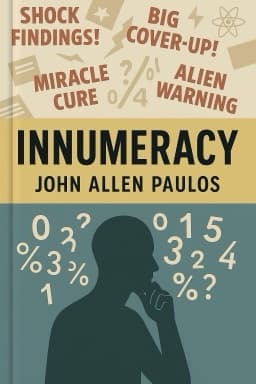
Why You’re More Innumerate Than You Think: The Shocking Truth About Math Illiteracy
Discover how countless people misunderstand numbers daily and what it means for your decisions.

Mathematics is often viewed as a specialized skill reserved for scientists or engineers, but its influence permeates every aspect of our lives. From understanding risks in health to interpreting polls and making financial decisions, numeracy—the ability to understand and work with numbers—is critical. Yet, an astonishing number of people suffer from innumeracy, a term popularized by John Allen Paulos to describe a widespread inability to grasp fundamental numerical concepts.
One of the most striking examples is the birthday paradox. Intuitively, many believe that in a room of 23 people, the chance two share a birthday is low. In reality, it's about 50%. This counterintuitive fact stems from the mathematics of combinations and highlights how our intuition often misleads us when dealing with probability.
Another foundational concept is the pigeonhole principle, which guarantees that if you have more items than containers, at least one container holds multiple items. This principle explains why certain coincidences are inevitable, such as two people sharing a birthday in a relatively small group.
Innumeracy extends beyond academic curiosity; it has real-world consequences. Misunderstanding statistics makes us vulnerable to pseudoscience—beliefs in astrology, ESP, or numerology—that prey on our inability to interpret probabilities correctly. For instance, many fail to grasp conditional probability, a concept essential in medical testing and legal reasoning, leading to costly errors.
Moreover, the complexity of societal decisions, such as voting or policy-making, involves trade-offs that require statistical literacy. Concepts like Condorcet’s paradox reveal how collective choices can be paradoxical, while the prisoner's dilemma illustrates the tension between individual and collective rationality.
Yet, numeracy is not an innate talent but a skill that can be developed. Foundations like the multiplication principle, the law of large numbers, and the central limit theorem provide tools to understand randomness and predictability. With education and a shift in mindset, we can overcome innumeracy’s barriers.
This blog aims to illuminate the hidden world of numbers that shape our daily lives and empower you to see through the fog of innumeracy. By understanding the principles John Allen Paulos details in his book, you can make better decisions, resist misinformation, and appreciate the beauty of mathematics in the world around you.
Are you ready to challenge your assumptions and embrace the power of numeracy? Let’s begin this enlightening journey.
References: Summary and insights derived from John Allen Paulos’ 'Innumeracy' and reviews from NewBookRecommendation.com, Sobrief.com, Bookey.app, and Complete-Review.com 1 2 3 4
Want to explore more insights from this book?
Read the full book summary