
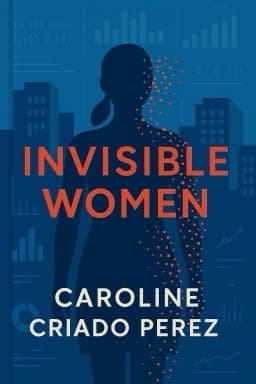
You Won’t Believe How Much the World Ignores Women: What ‘Invisible Women’ Reveals
How Everyday Objects, Policies, and Technologies Are Rigged Against Half the Population

How Everyday Objects, Policies, and Technologies Are Rigged Against Half the Population
If you’ve ever wondered why your smartphone feels too big, why you’re always cold at the office, or why public transport never seems to fit your daily routine, you’re not alone—and you’re not imagining things. Caroline Criado Perez’s ‘Invisible Women: Data Bias in a World Designed for Men’ pulls back the curtain on a world that, for centuries, has been built on a dangerous assumption: that men are the default human. This isn’t just a matter of inconvenience. It’s a matter of safety, health, and dignity.
Take cars, for example. Most crash test dummies are modeled on the average male body. The result? Women are 47% more likely to be seriously injured in a car crash. The problem doesn’t stop at vehicles. It’s everywhere: from the drugs we take (tested mostly on men) to the cities we live in (planned around male commuting patterns), to the very algorithms that decide who gets a job interview or a loan.
Perez’s book is a relentless catalog of these injustices, but it’s also a rallying cry. She shows that the gender data gap is not just an issue for women—it’s a societal flaw that affects everyone. When women’s needs go uncounted, entire communities suffer. For instance, when a Swedish city changed its snow-clearing policy to prioritize sidewalks and bus stops (used more by women), injuries and healthcare costs plummeted.
The book is packed with jaw-dropping statistics and stories, but the most powerful message is this: data is not neutral. What we choose to measure—and what we ignore—shapes the world we live in. The solution starts with awareness, but it doesn’t end there. Perez calls for systemic change: better data collection, inclusive design, and a fundamental rethinking of who gets to define ‘normal.’
‘Invisible Women’ is essential reading for anyone who wants to understand why the world feels off-balance—and what we can do to fix it. It’s a wake-up call, a roadmap, and a beacon of hope for a fairer, smarter, and safer world. The next time you wonder why something doesn’t quite work for you, remember: it’s not you. It’s the data gap. And together, we can close it. 1 2
Want to explore more insights from this book?
Read the full book summary