
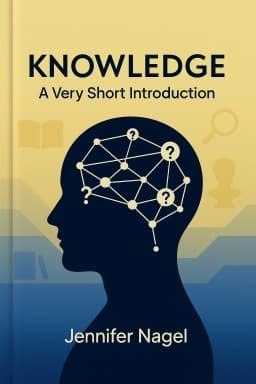
Unlocking the Mysteries of Knowing: What Jennifer Nagel’s Book Reveals About Truth and Belief
Why 'Knowledge: A Very Short Introduction' Is the Book You Need to Understand What You Really Know

Why 'Knowledge: A Very Short Introduction' Is the Book You Need to Understand What You Really Know
What does it mean to truly know something? Is knowledge just a collection of facts, or is it something deeper, more personal, and more elusive? Jennifer Nagel’s 'Knowledge: A Very Short Introduction' tackles these questions with clarity and warmth, drawing readers into the heart of one of philosophy’s oldest—and most relevant—debates. At first glance, knowing might seem simple. You know your name, the capital of France, and what you had for breakfast. But as Nagel shows, the moment you start to dig deeper, the ground beneath your feet begins to shift.
Imagine you believe the clock in your living room is accurate, and it tells you it’s 2 p.m. It is, in fact, 2 p.m.—but the clock stopped working yesterday. Do you really know the time, or are you just lucky? This is the famous Gettier problem, and it upends the traditional idea that knowledge is just justified true belief. Nagel uses such vivid, everyday examples to show how luck can sneak into our beliefs, making us question whether we ever truly know anything at all.
The book also explores the roots of philosophical scepticism, tracing the lineage from ancient Greek thinkers to modern debates about whether we could be dreaming right now. If you can’t prove you’re not dreaming, can you be sure of anything? These puzzles are not just abstract games—they shape how we trust our senses, our memories, and even the testimony of others.
Yet, Nagel doesn’t leave us lost in doubt. She introduces the reader to the great traditions of empiricism and rationalism, showing how knowledge can be built both from sensory experience and from the innate structures of reason. The book highlights how most of what we know comes not from direct experience, but from testimony—what others tell us. This social dimension of knowledge is crucial in the age of the internet, where information is shared, challenged, and sometimes manipulated at lightning speed.
Another key insight is the shifting standard of knowledge. What counts as 'knowing' in a casual conversation may not suffice in a courtroom or a scientific lab. Contextualism, as Nagel explains, helps us understand why our standards for knowledge change with the stakes and the setting.
Ultimately, Nagel’s book is a gentle companion for anyone who’s ever wondered, doubted, or debated. It teaches humility in the face of uncertainty and celebrates the adventure of lifelong learning. If you’ve ever asked yourself, 'How do I know what I know?' this book—and this blog—will help you find some answers, and perhaps even better questions.
Whether you’re a student, a teacher, or simply curious about the world, Nagel’s insights will change how you think about truth, belief, and the adventure of knowing. 1 2 3
Want to explore more insights from this book?
Read the full book summary