
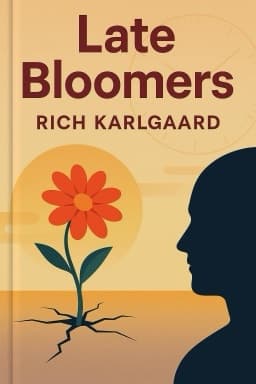
The Science Behind Late Blooming: Why Your Brain Needs Time to Shine
Exploring brain maturation and how it empowers late bloomers to excel

Many people feel pressured to achieve greatness early — to finish school, start careers, and make life-changing decisions before reaching their twenties. But neuroscience paints a different picture, one that offers hope and validation for late bloomers everywhere.
The Brain’s Extended Development
Unlike many organs, the human brain continues to develop well into adulthood. The prefrontal cortex, crucial for planning, impulse control, and complex decision-making, reaches full maturity around age 25. This means that young adults are still developing essential executive functions that enable wise choices and emotional regulation.
Multiple Cognitive Peaks
Not all mental abilities peak simultaneously. Processing speed and short-term memory may peak in adolescence or early adulthood, but vocabulary, emotional intelligence, and creative problem-solving often improve into middle age and beyond. This staggered development allows late bloomers to harness strengths that early bloomers may not yet possess.
Emerging Adulthood: A New Life Stage
Psychologists now recognize 'emerging adulthood' as a distinct phase, spanning roughly ages 18 to 25. This period is characterized by exploration, identity formation, and gradual assumption of adult responsibilities. Understanding this phase normalizes the often turbulent and uncertain experiences of young adults.
Implications for Education and Society
Rigid expectations for early success overlook these developmental realities, often leading to unnecessary stress and missed opportunities. Embracing a growth mindset that honors individual timelines can foster healthier educational and workplace environments.
Your brain is on its own schedule — and that’s a beautiful thing.
References:
Psychology Today: Confessions of a Late Bloomer
1
Inside Personal Growth Podcast: Late Bloomers with Rich Karlgaard
2
Want to explore more insights from this book?
Read the full book summary