
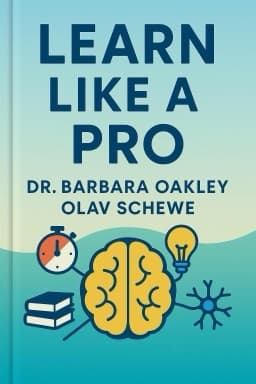
From Zero to Genius: How ‘Learn Like a Pro’ Turns You Into a Learning Machine
Transform your brain and habits to learn anything faster and retain it longer.

The Neuroscience Behind Learning
Your brain builds memories by forming synaptic connections between neurons. Active engagement, like self-testing and explaining concepts, strengthens these links, making recall easier. Passive reading creates weak connections prone to forgetting.
Balancing Focused and Diffuse Thinking
Focused mode tackles familiar problems with precision, while diffuse mode fosters creativity by connecting distant ideas during relaxed states. Alternating between these modes prevents mental blocks and sparks insight.
Memory Techniques: Mnemonics and the Memory Palace
Visual mnemonics and spatial memory techniques like the Memory Palace leverage the brain’s visual strengths. By associating information with vivid images and familiar places, you enhance memorization and retrieval.
Working Memory and Note-Taking Strategies
Working memory’s limited capacity means chunking and effective note-taking are essential. Techniques such as split notes and concept maps help organize information and facilitate review.
Procedural Learning and Intuition Development
Repeated practice builds procedural memory, enabling tasks to become automatic and intuitive. This frees cognitive resources for higher-level thinking and creativity.
Self-Discipline, Motivation, and Metacognition
Willpower is limited but can be managed by forming habits and removing distractions. Social support enhances motivation. Metacognition—reflecting on your learning—helps you adapt and improve continuously.
Conclusion: Embrace Lifelong Learning
Integrating these strategies empowers you to become a lifelong learner, adaptable and resilient in a changing world. Learning becomes not a chore but a source of joy and growth.
Want to explore more insights from this book?
Read the full book summary