
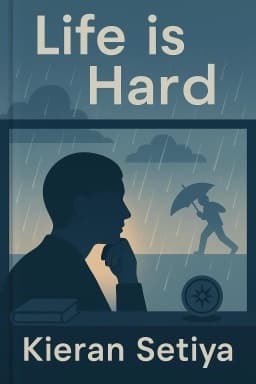
Why Life Is Hard: The Surprising Philosophy That Can Change Your Pain Into Power
Discover how philosophy transforms the inevitability of pain and suffering into a source of strength and self-understanding.

We all know life is hard. From the moment we face physical pain or illness to the inevitable experiences of loneliness, grief, failure, and injustice, hardship is woven into the fabric of our human existence. But what if these difficulties are not just burdens to bear but profound teachers that can deepen our understanding of ourselves and the world? This is the transformative insight offered by a remarkable philosophical approach that invites us to rethink suffering not as a meaningless curse but as a vital part of the human story.
At the heart of this philosophy is the recognition that physical pain and disability, often seen as purely negative, are complex phenomena. Pain is not simply a malfunction but a language of the body signaling distress. Chronic pain, in particular, is a paradoxical state—pain that misrepresents the body but never deceives about suffering itself. Understanding this helps us approach pain with compassion and patience, knowing that relief is often subtle and the absence of pain can feel like a quiet background rather than a dramatic joy. Disability, meanwhile, is not inherently harmful; its impact depends largely on social attitudes and accommodations. This shifts the focus from individual tragedy to collective responsibility for inclusion and dignity.
Loneliness, another universal hardship, is distinct from solitude. While solitude can be a chosen and peaceful state, loneliness is the painful experience of social disconnection. It harms physical health and accelerates aging, yet true friendship—rooted in unconditional recognition of human dignity—offers a powerful remedy. Friendship heals loneliness not by utility or admiration but by affirming our intrinsic worth. This moral foundation of friendship teaches us that connection is essential to well-being and human flourishing.
Grief, too, is a complex and nonlinear process. It comes in unpredictable waves and cannot be rushed or neatly categorized into stages. Mourning rituals across cultures provide structure and communal support, helping us navigate the chaos of loss. Importantly, grief is a manifestation of love; the pain we feel reflects the depth of our attachments. Recognizing grief as love’s expression transforms it from a burden into a testament of enduring connection.
Failure challenges the dominant cultural narratives that equate worth with success. It is culturally constructed and often stigmatized, yet failure is inevitable and necessary. Distinguishing between telic activities (with fixed goals) and atelic activities (ongoing without endpoint) helps us value process over outcome and cultivate resilience. Embracing the fragmented, digressive nature of life’s story allows us to hold failure lightly and continue forward with grace.
Injustice, pervasive and systemic, harms victims and morally corrupts perpetrators. It requires collective responsibility and political agency to address structural inequities. Moral attention—the act of seeing and acknowledging suffering—is foundational to justice. Without it, injustice remains invisible and unchallenged. Engaging with injustice is essential for living well, as happiness divorced from justice is hollow.
Finally, hope emerges as a complex virtue combining desire and belief amid uncertainty. It coexists with fear and despair but motivates courageous engagement with life’s challenges. Hope is not passive wishfulness but the fragile bird that sings in the soul, inspiring resilience, justice, and meaning.
Through these insights, philosophy offers a practical guide to living well despite life’s hardships. It invites us to face suffering with openness, cultivate connection, embrace imperfection, seek justice, and nurture hope. In doing so, we find not only endurance but a deeper, richer way to live.
For those seeking to understand and transform their experience of hardship, this approach provides a beacon of light—showing that even in the darkest moments, life’s challenges hold the seeds of growth and meaning.
Explore further how these timeless themes resonate in our daily lives and how you can apply philosophical wisdom to nurture resilience and hope in your own journey.
Sources: Life Is Hard by Kieran Setiya, Philosophy A Way of Life website, Goodreads reviews, Amazon book descriptions.
Want to explore more insights from this book?
Read the full book summary