
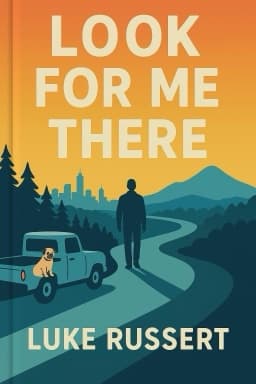
How Travel Healed My Grief: Lessons from Luke Russert’s ‘Look for Me There’
Discover how Luke Russert turned heartbreak into hope across 67 countries.

Discover how Luke Russert turned heartbreak into hope across 67 countries.
If you’ve ever lost someone you love, you know how the world can suddenly feel both too small and impossibly vast. In his deeply moving memoir, Look for Me There, Luke Russert invites us into the raw aftermath of losing his father, Tim Russert—a figure beloved by millions, but even more so by his only son. What follows is not just a tale of sorrow, but a blueprint for healing, resilience, and personal transformation.
Russert’s journey begins in Florence, Italy, where he receives the devastating news. Instantly, his world shifts, and the rituals of mourning are complicated not only by distance, but by the public nature of his grief. His father’s passing was not just a family affair; it was a national event, with media attention and public condolences pouring in. Yet, amid the chaos, a simple rainbow arching over the Kennedy Center after the funeral becomes a sign that hope is never far away—a motif that recurs throughout his travels.
Determined not to be defined by legacy or public expectation, Russert leaves behind a prestigious career in journalism. The decision is met with skepticism, but it is also the first step toward reclaiming his identity. He embarks on a solo odyssey—first through the forests of Maine, then across continents. Inspired by classic travelogues, he seeks solace in nature and the unknown, accompanied only by his loyal pug, Chamberlain. These moments of solitude, sometimes perilous, become fertile ground for self-reflection and healing.
Travel, Russert discovers, is a teacher. In bustling South American markets, sacred Asian temples, and the wilds of Patagonia, he learns humility, empathy, and the universality of loss. The world, with all its diversity, becomes a mirror for his own journey. Conversations with strangers, local guides, and fellow travelers often provide the wisdom he sought from books or mentors back home. Each setback—missed flights, language barriers, moments of loneliness—becomes an opportunity to build resilience.
Family remains a central theme. Traveling with his mother through South America, Russert finds new depth in their relationship. Honest conversations about legacy, forgiveness, and shared grief help both heal. His mother’s advice—to collect objects with stories, not just souvenirs—becomes a guiding principle. Legacy, he learns, is not just something to inherit, but something to redefine and pass on.
Returning home, Russert is changed. Success is no longer measured by public acclaim, but by authenticity and service to others. Healing, he realizes, is not a straight line but a lifelong process. The book closes on a note of hope: that every journey, no matter how uncertain, brings us closer to understanding ourselves and embracing the present moment.
Russert’s memoir is a powerful reminder that, in the face of grief, we can find healing not by escaping our pain, but by moving through it—one step, one mile, one story at a time. For anyone seeking inspiration, comfort, or a path forward, Look for Me There is a must-read guide to the resilience of the human spirit.
Want to explore more insights from this book?
Read the full book summary