
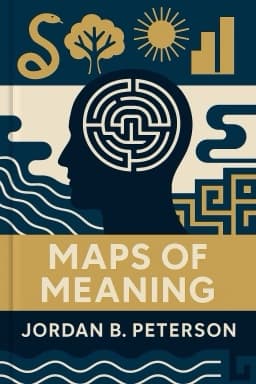
Why 'Maps of Meaning' Will Change the Way You See Everything (Even If You Don’t Finish It)
Unlocking the Hidden Patterns of Life, Belief, and Survival

Unlocking the Hidden Patterns of Life, Belief, and Survival
Imagine waking up each morning not with a sense of certainty, but with a quiet question: How do I make sense of this world? This is the starting point of Jordan B. Peterson’s ‘Maps of Meaning,’ a book that has become a cult classic for seekers, skeptics, and scholars alike. More than a self-help manual or a dry academic treatise, ‘Maps of Meaning’ is an exploration of what it means to be human in a universe that is both terrifyingly chaotic and deeply meaningful.
At its core, the book argues that belief systems are not mere cultural artifacts or arbitrary traditions—they are survival tools. Peterson’s journey began with personal nightmares about nuclear war and existential threat, leading him to ask why humans throughout history have created myths and stories with similar structures. The answer, he found, is that these stories encode the wisdom of generations, teaching us how to navigate the unknown and find meaning in the face of suffering.
‘Maps of Meaning’ weaves together insights from mythology, neuroscience, and psychology. Peterson explains that life is a constant dance between order (the known, the safe, the routine) and chaos (the unknown, the dangerous, the new). Every crisis, whether personal or collective, is a moment when our old maps fail and we are forced to redraw the boundaries between what we understand and what we fear.
One of the most powerful sections of the book explores the hero’s journey—a narrative found in every culture, from ancient epics to modern films. The hero leaves the comfort of the familiar, faces trials in the unknown, and returns transformed, bringing new knowledge or renewal to the community. This pattern is not just a story; it’s a blueprint for growth and adaptation. Peterson uses vivid examples to show how each of us is called to be the hero in our own lives, especially during times of crisis.
The book also delves into the biology of meaning. When we encounter something new, our brains respond with both fear and curiosity—preparing us to either retreat or explore. The search for meaning is not just philosophical; it’s a biological imperative. When our experiences make sense, the brain rewards us with positive emotions. When they don’t, we feel anxiety and confusion. Peterson’s message is clear: adaptation and resilience depend on our ability to update our maps, integrating new experiences and lessons.
But there is a warning here, too. When belief systems become rigid—when our maps become prisons rather than guides—we risk falling into ideological possession. Peterson is especially critical of ideologies that offer false certainty, suppress dissent, and punish curiosity. He urges readers to remain open, flexible, and humble, recognizing that the search for meaning is a lifelong journey, not a final destination.
In the end, ‘Maps of Meaning’ is an invitation to become both the author and the hero of your own story. It challenges you to confront chaos, learn from crisis, and continually revise your understanding of the world. Whether you finish the book or not, its insights will linger, changing the way you see yourself and the world around you.
For those willing to take the journey, ‘Maps of Meaning’ offers a roadmap for living with courage, resilience, and hope.
Sources:
1
2
4
Want to explore more insights from this book?
Read the full book summary