
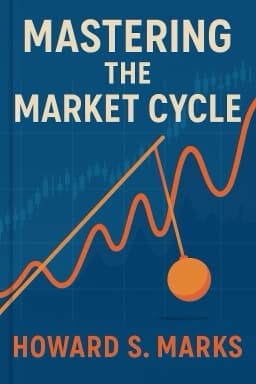
Unlocking the Hidden Rhythms of Markets: How Mastering Cycles Can Transform Your Investing
Discover the secret patterns behind market ups and downs and how to harness them for smarter investing

Have you ever wondered why markets seem to move in waves, sometimes soaring to euphoric highs only to plunge into despair? The answer lies in the concept of market cycles — the natural rhythms that govern economic activity, corporate profits, investor psychology, and risk appetite. Howard Marks, one of the world’s most respected investors, has illuminated these patterns in his work on mastering market cycles, offering a roadmap to navigate the often turbulent seas of investing.
At the heart of Marks’ philosophy is the idea that cycles are inevitable and continuous. They oscillate around a midpoint or secular trend, never truly starting or ending but flowing like the changing seasons. This perspective shifts the investor’s focus from futile attempts at precise timing to understanding phases and tendencies.
Economic cycles form the foundation of these oscillations. While the long-term trend of economic growth is steady, short-term fluctuations driven by consumer confidence, business investment, and external shocks create booms and busts. Governments and central banks act as helmsmen, using monetary and fiscal tools to moderate these swings. However, their interventions come with timing challenges and unintended consequences, such as asset bubbles and debt accumulation.
Corporate profits often amplify economic cycles. Due to operating and financial leverage, profits rise faster than sales during expansions and fall more sharply during contractions. Additionally, idiosyncratic factors like technological disruption and management decisions can cause profits to diverge from economic trends, adding volatility to markets.
One of the most powerful forces shaping market cycles is investor psychology. The emotional pendulum swings between greed and fear, optimism and pessimism, credulity and skepticism. These intertwined emotions create feedback loops that push markets beyond rational valuations, leading to euphoric booms and panic-driven busts. Successful investors resist these extremes, maintaining discipline and contrarian thinking.
Risk tolerance itself is cyclical. During booms, complacency lowers risk premiums, encouraging risk-taking and yield chasing, which increases market vulnerability. In downturns, fear expands risk premiums, making safety more attractive and creating opportunities for disciplined investors. Understanding this risk spectrum helps in calibrating portfolio exposure effectively.
Mastering the cycle ultimately means positioning portfolios to tilt the odds in your favor. This involves balancing aggressiveness and defensiveness along a continuum, adjusting exposure incrementally as cycle conditions evolve. No strategy can eliminate uncertainty, but cycle-based positioning improves the probability of success over time.
By embracing the rhythm of cycles, investors transform a seemingly chaotic market into a structured landscape rich with opportunity. This approach demands patience, discipline, and a deep understanding of the forces at play. Yet, it offers the promise of navigating markets with confidence and achieving enduring investment success.
For those seeking to dive deeper, multiple sources provide valuable insights. Oaktree Capital’s extensive analysis offers ongoing commentary on market trends, while detailed book summaries and expert blogs unpack Howard Marks’ lessons with practical applications. Integrating these perspectives enriches your understanding and sharpens your investment acumen.
In the end, mastering market cycles is less about predicting the future and more about understanding the past and present — seeing patterns where others see randomness, and responding thoughtfully rather than reactively. It is a journey of continual learning and adaptation, one that can transform your approach to investing and your financial future.
References: 1 , 2 , 3 , 4
Want to explore more insights from this book?
Read the full book summary