
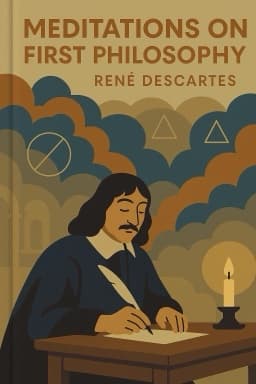
The Science Revolution You Didn’t Know Was Inspired by Descartes
How a Philosopher’s Quest for Certainty Sparked the Age of Discovery

How a Philosopher’s Quest for Certainty Sparked the Age of Discovery
When you think of the scientific revolution, you might picture telescopes, test tubes, and daring experiments. But behind these tools was a revolution in thinking, sparked by René Descartes’ insistence on clarity, doubt, and logical method. His Meditations challenged scholars to question everything, test every assumption, and accept only what could be proven with clarity and certainty.
Descartes’ influence can be seen in the work of Isaac Newton, Robert Boyle, and countless others who demanded that science be grounded in reason, not tradition. His method of systematic doubt became the foundation for the scientific method: observe, hypothesize, test, and repeat. Today, every scientific discovery—from vaccines to space exploration—owes something to Descartes’ vision.
But Descartes’ legacy is not just historical. His emphasis on clear thinking, skepticism, and the search for underlying causes continues to drive innovation in physics, medicine, and technology. The next time you marvel at a medical breakthrough or a stunning image from a space telescope, remember that it all began with a philosopher asking, 'What can I know for sure?'
For more on Descartes’ impact on science, see
1
,
3
.
Want to explore more insights from this book?
Read the full book summary