
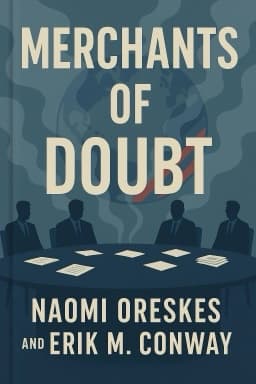
How Industries Turned Doubt Into a Weapon: The Untold Story Behind 'Merchants of Doubt'
The Playbook That Changed How We Think About Science—and Why It Still Matters Today

The Playbook That Changed How We Think About Science—and Why It Still Matters Today
Imagine a world where the facts are clear, but confusion reigns. In 'Merchants of Doubt,' Naomi Oreskes and Erik Conway reveal how this world became our reality—not by accident, but by design. The book meticulously documents how a handful of influential scientists, often backed by industry money, created an elaborate system to manufacture doubt around scientific issues that threatened powerful interests. The story begins with tobacco: as evidence mounted that smoking caused cancer, the industry responded not by improving safety, but by launching a campaign to make the science seem uncertain. Their internal memos were chillingly direct: 'Doubt is our product.' This strategy proved so successful that it became the template for future battles over acid rain, the ozone hole, and, most significantly, climate change.
The machinery of doubt included funding 'independent' think tanks, hiring PR firms to shape public messaging, and cultivating a stable of scientists willing to challenge consensus. These experts, often physicists with Cold War credentials, lent their authority to causes well outside their expertise. Media outlets, striving for balance, gave these minority voices equal weight, amplifying the illusion of debate. The result was a public paralyzed by uncertainty—unsure whom to trust, and thus less likely to support regulation or change.
As the strategy spread, it delayed action on critical issues. Acid rain continued to devastate forests while industry-funded scientists argued it was a natural phenomenon. The ozone hole widened as PR campaigns insisted that the science was incomplete. Climate change, the most consequential battle, saw the same tactics escalate: denial of warming, blaming natural cycles, and finally claiming that adaptation was easier than prevention. Throughout, the machinery of doubt exploited the public's misunderstanding of scientific uncertainty—turning the natural caution of science into a weapon against itself.
The consequences have been profound. Regulations were delayed for years, lives were lost, and public trust in science eroded. Yet, as 'Merchants of Doubt' makes clear, the solution is not cynicism but vigilance. Transparency in research funding, media literacy, and citizen engagement are crucial defenses. Today, as new controversies arise—from vaccine safety to environmental protection—the lessons of this book are more urgent than ever. Understanding the history of manufactured doubt empowers us to resist its influence, defend evidence-based policy, and restore faith in the scientific process.
1
3
Want to explore more insights from this book?
Read the full book summary