
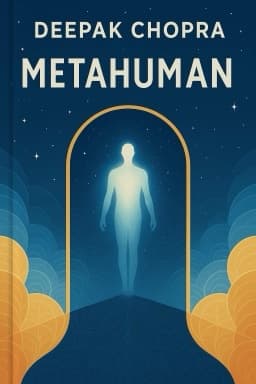
Unlocking the Metahuman Within: 7 Surprising Truths From Deepak Chopra’s Mind-Bending Bestseller
How Chopra’s Metahuman Can Change the Way You See Reality—And Yourself

How Chopra’s Metahuman Can Change the Way You See Reality—And Yourself
What if the world you see isn’t the world as it is, but the world as you are? Deepak Chopra’s 'Metahuman' challenges everything you think you know about life, consciousness, and your own potential. Drawing from ancient Eastern philosophy, modern neuroscience, and personal transformation stories, Chopra invites us to wake up from the dream of separation and limitation.
One of the book’s most radical ideas is that our senses do not show us reality, but a filtered, self-constructed version of it. For example, the colors you see and the sounds you hear are not properties of the outside world, but interpretations created by your brain. Even pain, Chopra notes, is profoundly subjective—two people can have wildly different experiences of the same stimulus. This realization is liberating: if your experience is created, it can also be recreated.
Chopra guides readers through the emergence of the ego—the sense of 'I'—and how it shapes our daily lives. He explains that the ego is both necessary and limiting: it helps us navigate the world, but also creates boundaries that can become prisons. The ego’s story is one of endless wanting and comparison, but it is not the whole story. By recognizing the ego’s patterns, we can begin to step beyond them.
Perhaps the most hopeful message in 'Metahuman' is the idea of infinite potential. Chopra shares examples of sudden genius, creative breakthroughs, and even spontaneous healing—moments when people transcend their usual limitations. He links this to the science of neuroplasticity and epigenetics, showing that our brains and genes are far more flexible than once believed. Meditation and mindfulness, he argues, are keys to unlocking this potential.
Freedom, for Chopra, is not found by controlling the world, but by seeing through its illusions. He uses the metaphor of virtual reality to show how easily the mind can be tricked—and how awareness can always step back and choose a new perspective. Practices like breathwork and present-moment awareness help us dissolve suffering and access peace.
Ultimately, Chopra invites us to see mind, body, and universe as one unified field of consciousness. This is not just a mystical idea, but one supported by quantum physics and modern biology. Matter is mostly empty space, and meaning is created only in the mind. When we live from this awareness, every relationship and action becomes an expression of unity and love.
Chopra offers a month-long program of daily practices—meditation, journaling, acts of kindness—to help anchor these insights in real life. He emphasizes that transformation is gradual, the result of small, consistent actions. Even five minutes of presence each day can lead to profound change over time.
In the end, 'Metahuman' is a call to remember who you really are: not a separate self, but an infinite field of awareness, creativity, and possibility. The world is not outside you—it is in you. The horizon of your life is as wide as your willingness to awaken.
Ready to unlock your metahuman potential? The journey starts now.
Want to explore more insights from this book?
Read the full book summary