
Article from Book Summary
The Ultimate Mindware Toolkit: 10 Essential Tools for Smart Thinking
A Practical Guide to the Most Powerful Tools from Mindware

Reading Revolution
February 9, 20232.7K views
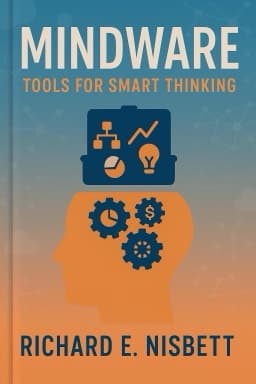
Mindware: Tools for Smart ThinkingRichard E. Nisbett
What if you could upgrade your brain with a set of mental tools that help you solve problems, make better decisions, and understand the world more clearly? That’s the promise of Richard Nisbett’s 'Mindware.' This blog breaks down the ten most essential tools from the book, showing how to use each one in daily life.
- Schemas: Mental templates that help us interpret new information quickly, but can also lead to bias.
- Heuristics: Shortcuts in thinking that save time but sometimes mislead us—like judging by similarity or vividness.
- Opportunity Cost: Every choice means giving up something else—recognizing this helps us make smarter decisions.
- Statistical Reasoning: Understanding probability, sample size, and randomness protects us from common errors.
- Cost-Benefit Analysis: Weighing pros and cons helps clarify the best path forward.
- Understanding Causality: Don’t confuse correlation with causation—look for hidden variables and test with experiments when possible.
- Logic: Formal reasoning helps us avoid contradictions and build strong arguments.
- Dialectical Thinking: Balancing opposing ideas leads to deeper understanding and better solutions.
- Choice Architecture: How options are presented can nudge us toward better outcomes.
- Self-Compassion: Recognizing our own limits fosters growth, resilience, and kindness.
Each tool is illustrated with practical examples, showing how to apply them to everything from choosing a career to resolving conflicts. By mastering these tools, you can become a more effective thinker and a wiser person.
Want to explore more insights from this book?
Read the full book summary