
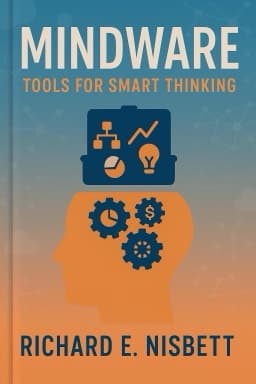
Why Smart People Make Dumb Decisions—and How Mindware Can Help
The Hidden Traps of the Mind and the Tools to Outsmart Them

It’s a paradox that puzzles many: why do people with high IQs, advanced degrees, and impressive credentials sometimes make the worst decisions? Richard Nisbett’s 'Mindware' provides the answer, showing that intelligence alone isn’t enough—what matters is how we use it. The book reveals that cognitive biases, faulty heuristics, and environmental influences can trip up even the brightest minds. But there’s hope: by equipping ourselves with the right mindware, we can sidestep these traps and make consistently better choices.
The Lure of Intuition: Our gut feelings can be powerful, but they’re also prone to error. Nisbett explains how intuition is shaped by experience and context, but it’s not always reliable—especially in unfamiliar situations. For instance, overconfidence in one’s judgment can lead to disastrous investments or poor business strategies. The key is to balance intuition with analytical thinking, especially when the stakes are high.
Context Is King: We like to think of ourselves as independent actors, but research shows that our decisions are heavily influenced by our environment. Social context, roles, and even subtle cues like lighting or background music can nudge us in unexpected directions. This is why it’s so important to design environments that promote good choices—whether in the workplace, at home, or in public policy.
The Power of Statistical Thinking: Many errors stem from a lack of statistical literacy. We’re quick to see patterns where none exist and to draw conclusions from small samples. Nisbett emphasizes the importance of understanding probability, avoiding the illusion of control, and recognizing when randomness is at play. This mindset can protect us from costly mistakes in everything from investing to healthcare.
Applying Mindware to Daily Life: The tools in 'Mindware' aren’t just for academics—they’re for everyone. By considering opportunity costs, ignoring sunk costs, and weighing evidence objectively, we can make wiser choices in our personal and professional lives. The book is filled with practical advice, such as writing out pros and cons, seeking diverse perspectives, and being open to changing your mind in light of new evidence.
Real-World Examples: The blog draws on famous examples from business, politics, and science to illustrate how ignoring mindware leads to failure. Whether it’s a company sticking with a doomed product because of sunk costs or policymakers misreading statistical data, the consequences can be severe. Learning these lessons is the first step toward smarter, more resilient decision-making.
Conclusion: 'Mindware' is a wake-up call for anyone who wants to avoid the pitfalls of human thinking. By adopting its tools, we can outsmart our own biases and make choices that lead to better outcomes for ourselves and those around us.
Want to explore more insights from this book?
Read the full book summary