
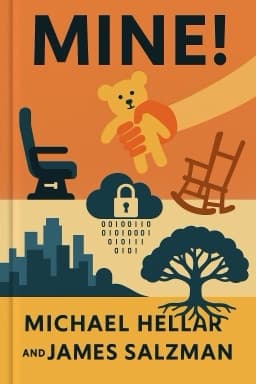
Who Really Owns What? The Shocking Truth About Ownership You Never Knew
Unlocking the Hidden Rules That Shape Our World and Our Lives

Unlocking the Hidden Rules That Shape Our World and Our Lives
We live in a world obsessed with ownership. We mark our territory with fences, sign contracts, and swipe credit cards to claim what’s ours. But have you ever stopped to wonder:
In Mine!: How the Hidden Rules of Ownership Control Our Lives, Michael Heller and James Salzman peel back the layers of ownership to reveal a startling truth: ownership is not a fixed, universal concept but a flexible, contested, and often invisible set of rules that society designs and enforces. These rules determine who benefits, who loses, and how resources flow through our lives.
Take the seemingly innocent act of standing in line. You might think that the first person to arrive gets served first — a simple, fair rule. But in today’s world, lines have become commodities. In New York, people pay others to stand in line for coveted Supreme Court seats or concert tickets. Disney charges thousands for VIP tours that let guests skip lines. Automated bots snatch up theater tickets in milliseconds.
Possession itself is deeply primal. In Boston, after a massive blizzard, residents began placing chairs in the street to 'reserve' parking spots they cleared. This symbolic possession sparked fierce neighborhood disputes and revealed how physical control translates into social ownership. Similar battles rage on airplanes over seat saving with jackets and iPads, or among surfers defending their favorite waves.
Ownership also hinges on labor — the effort and creativity poured into making something. Yet, this principle is complicated in intellectual property, where fashion designs are copied freely while music and speeches are fiercely guarded. The commercialization of cultural legacies, like iconic civil rights speeches controlled by corporations decades later, raises profound questions about who truly owns ideas.
The boundaries of ownership extend vertically too — not just land but the air above and the ground below. Drones flying over backyards challenge traditional property rights, and excessive groundwater pumping causes land to sink, affecting neighbors and infrastructure. Our homes are no longer castles with clear walls but contested spaces shaped by technology and environment.
Family ownership and inheritance laws further complicate the picture. Fractionated heir property often leads to forced sales, disproportionately harming marginalized communities. Meanwhile, wealthy families use trusts to preserve assets and avoid taxes, contributing to growing inequality. Marital ownership rules differ by state, influencing financial security and power dynamics within households.
Ownership rules also shape social inequality. Carpool lanes reserved for multiple passengers or electric cars can be bought by solo drivers through dynamic tolling, favoring the wealthy. Food truck restrictions protect established restaurants but limit immigrant entrepreneurship. Even programs designed for equity, like disability access passes at Disney, can be exploited, forcing policy changes.
At the frontier of environment and digital realms, ownership is evolving rapidly. New York’s innovative watershed protection pays landowners to safeguard water quality, aligning private stewardship with public good. Fisheries use catch shares to prevent overfishing. Yet, digital ownership often means limited licenses, allowing companies to remove content or disable devices remotely, challenging traditional consumer rights.
Ultimately, ownership is a tool of social engineering, flexible and strategic. Ambiguity in ownership rules can be leveraged to manage conflicts or gain advantage. Understanding these hidden rules empowers us to navigate ownership systems wisely, advocate for fairness, and shape a more equitable future.
So next time you say 'mine,' remember: ownership is not just about possession but a story we tell ourselves about control, justice, and belonging. Knowing the rules lets you play the game smarter and maybe even change it.
Want to explore more insights from this book?
Read the full book summary