
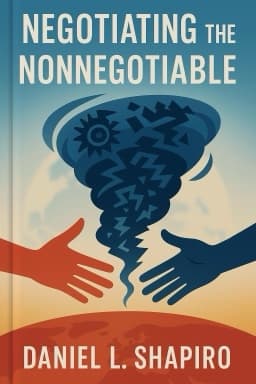
Breaking Taboos and Healing Sacred Values: The Hidden Keys to Lasting Peace
How understanding and respecting taboos and sacred values can unlock breakthroughs in the toughest conflicts.

Some topics are forbidden, some values untouchable — yet these very elements often lie at the heart of the most intractable conflicts. Daniel Shapiro’s Negotiating the Nonnegotiable sheds light on the powerful roles of taboos and sacred values in shaping human disputes.
Taboos are social prohibitions that silence certain conversations or actions to protect what a community holds sacred. Derived from the Polynesian word 'tabu,' they involve prohibition, punishment, and protective significance. While taboos maintain social cohesion, they also create invisible walls that hinder honest dialogue and perpetuate misunderstandings.
For instance, in some cultures, discussing death openly is taboo, making it difficult to address grief or end-of-life decisions. In families, topics like mental health or finances may be off-limits, breeding resentment and secrecy.
Shapiro emphasizes the importance of creating safe zones where taboo subjects can be explored without fear of social punishment. Techniques like the ACT system — Accept, Chisel, Tear — guide how to respectfully engage or dismantle taboos when necessary.
Closely tied to taboos are sacred values, infinite and inviolable beliefs that define identity. Attacks on these values provoke existential threats, making compromise feel impossible. Shapiro identifies four spheres of identity that influence responses to sacred values: Fundamentalist, Constructivist, Anattist, and Quantumist.
Understanding these perspectives helps negotiators tailor approaches that respect sacred values while seeking common ground. For example, acknowledging a community’s sacred land rights can open dialogue that would otherwise be blocked by mistrust.
By breaking down invisible walls and honoring what is sacred, parties can transform conflict from a battlefield into a bridge toward lasting peace.
Sources: Harvard Program on Negotiation, Amazon reviews, Blinkist summary [[3]](#__3) [[0]](#__0) [[2]](#__2)
Want to explore more insights from this book?
Read the full book summary