
Unlocking the Secrets of 'Negotiating the Nonnegotiable': How to Resolve Conflicts That Seem Impossible
Discover the profound insights from Daniel Shapiro’s groundbreaking book on mastering the art of resolving deep-rooted conflicts by understanding identity and emotions.

Conflicts are an inevitable part of life, but some disputes feel impossible to solve. Whether it's a family feud, a workplace standoff, or a geopolitical crisis, the deeper issues often lie beneath surface disagreements. Daniel L. Shapiro’s Negotiating the Nonnegotiable dives into this hidden terrain, revealing that identity and emotions are the true battlegrounds of conflict.
At the heart of Shapiro’s thesis is the idea that conflicts are rarely about facts or positions alone. Instead, they are struggles over identity — who we are, how we relate to others, and what we hold sacred. He distinguishes between core identity, the stable foundation of beliefs and values, and relational identity, the dynamic emotional connections that define our relationships.
This dual identity framework explains why conflicts escalate when people feel their core or relational identities are threatened. For example, a seemingly trivial argument can spiral out of control if one party feels disrespected or rejected on a deep emotional level.
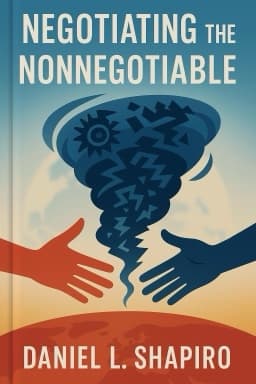
Shapiro introduces the concept of vertigo, an emotional tornado that traps people in conflict by narrowing their focus and warping their perception of time and space. Vertigo blinds individuals to alternative perspectives and fuels cycles of misunderstanding.
Another powerful force is the repetition compulsion, where people unconsciously reenact painful conflict patterns rooted in unresolved emotional wounds. This cycle is automatic and resistant to change, requiring deliberate strategies to break free.
Taboos — unspoken social prohibitions — create invisible walls that silence critical dialogue. These taboos protect what communities hold sacred but also complicate resolution by making certain topics forbidden. Shapiro offers ways to safely navigate these sensitive areas.
Central to many conflicts are sacred values, infinite and inviolable beliefs that define identity. Attacks on these values escalate disputes dramatically, as compromising them feels like existential loss. Understanding different identity spheres helps tailor approaches to reconcile these values.
Shapiro also explores identity politics, where group loyalties are weaponized for political gain, often deepening divisions. Recognizing and protecting oneself from such manipulation is key to maintaining constructive dialogue.
Yet amidst these challenges lie integrative dynamics, the positive forces that encourage empathy, cooperation, and mutual benefit. Balancing autonomy and affiliation enables parties to shift from adversaries to collaborators by building shared narratives and respect.
Finally, Shapiro emphasizes healing and transformation. Conflict, approached with courage and compassion, can catalyze growth and renewed relationships. Identity is fluid enough to allow for reconciliation and new beginnings.
By weaving psychological insight with practical tools, Negotiating the Nonnegotiable offers a roadmap for anyone seeking to resolve conflicts that feel unsolvable. It invites us to look beneath the surface, understand the emotional and identity dimensions, and embrace conflict as an opportunity for connection and growth.
Whether you are a mediator, leader, or simply someone navigating difficult relationships, this book provides invaluable guidance to transform conflict into healing. Start your journey today by recognizing the power of identity and emotions in every negotiation.
Sources: Amazon reviews, Blinkist summary, Harvard Program on Negotiation resources [[0]](#__0) [[2]](#__2) [[3]](#__3)
Want to explore more insights from this book?
Read the full book summary