
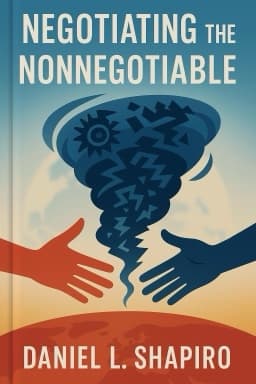
Why Your Conflicts Keep Getting Worse: The Psychology Behind 'Negotiating the Nonnegotiable'
Uncover the hidden psychological forces that trap us in destructive conflict cycles and how to break free.

Have you ever felt trapped in a conflict that seems to repeat itself endlessly, growing more intense with each encounter? This experience is not uncommon, and Daniel Shapiro’s Negotiating the Nonnegotiable explains why.
One of the central psychological forces Shapiro identifies is vertigo — an emotional tornado that consumes our attention and narrows our perspective. When caught in vertigo, time distorts, and our ability to reflect or empathize diminishes. We become prisoners of our own emotional storm, unable to step back and see the bigger picture.
Vertigo is dangerous because it operates outside our conscious awareness. We believe we are thinking clearly when, in reality, our perceptions are warped and our reactions automatic. This can escalate conflicts rapidly, as each party becomes more entrenched and reactive.
Equally compelling is the concept of repetition compulsion. People unconsciously recreate familiar conflict scenarios rooted in past emotional wounds. This compulsion is automatic and resistant to change, making it difficult to break free even when we recognize the pattern.
For example, someone who experienced abandonment in childhood might trigger arguments in adult relationships that mirror that pain. Without deliberate intervention, these cycles continue, causing frustration and despair.
Shapiro offers hope through deliberate strategies: identifying triggers early, resisting the pull of old patterns, reclaiming emotional clarity, and introducing new behaviors. These steps require courage and patience but can lead to profound transformation.
Understanding these hidden psychological dynamics is crucial for anyone seeking to resolve conflicts effectively. It explains why traditional negotiation tactics often fail and highlights the need for emotional intelligence and identity awareness.
Whether in personal relationships or professional settings, this knowledge empowers us to break destructive cycles and create new pathways toward peace.
Sources: Pastor Matthew Best reflections, Blinkist summary, Amazon reviews [[1]](#__1) [[2]](#__2) [[0]](#__0)
Want to explore more insights from this book?
Read the full book summary