
The Climate Crisis Is Triggering a Migration Wave Like Never Before — Are We Ready?
How the escalating climate emergency is reshaping human migration and what it means for our future

In recent decades, the world has witnessed an unprecedented acceleration of climate change, with rising carbon dioxide levels reaching 420 parts per million — a concentration not seen in millions of years. This rapid warming has unleashed a series of environmental calamities: melting ice sheets contributing to rising sea levels, record-breaking heatwaves baking continents, and an increase in wildfires, droughts, and floods. These forces, often called the Four Horsemen of the Anthropocene, are reshaping the planet’s livability and forcing human populations to move in search of safety and opportunity.
Historically, in the 19th century, about 14% of the global population were migrants, moving to new lands for better prospects. Now, despite a population nearly four times larger, only 3% of people live as international migrants. This decline is not due to a lack of desire or necessity but rather the imposition of restrictive policies that ignore migration’s vital role in economic growth and social resilience.
Economic analyses reveal that migrants contribute approximately 10% of the global GDP, often exceeding what they would produce in their countries of origin. Remittances sent back home amount to trillions annually, surpassing official foreign aid and uplifting millions from poverty. In aging societies, migrants fill critical labor shortages, sustaining healthcare, agriculture, and industries. Moreover, diverse migrant communities fuel innovation, cultural richness, and social dynamism.
However, the rapid urbanization driven by migration presents challenges. A new million-person city is expected to be built every ten days for the next eighty years, with megacities merging into mega-regions housing over 100 million people. Many migrants initially settle in informal settlements with inadequate infrastructure, highlighting the urgent need for sustainable urban planning, investment in housing, sanitation, and public services.
Feeding and powering these growing populations require transformative shifts. Transitioning to plant-based diets can reduce agricultural land use by up to 75%, easing environmental pressures. Renewable energy sources like solar and wind have become cheaper than coal, accelerating the energy transition. Water scarcity looms as a critical threat, necessitating innovations such as desalination and recycling to secure fresh water supplies.
Equally important is restoring biodiversity and ecosystems. Species extinction rates are now 100 to 1,000 times higher than natural levels, threatening the very ecosystems that sustain life. Reforestation, wetland recovery, and coral reef restoration, combined with carbon capture technologies, offer pathways to mitigate climate change and preserve planetary health. Yet, geoengineering approaches like solar radiation management carry risks and ethical dilemmas that require careful governance.
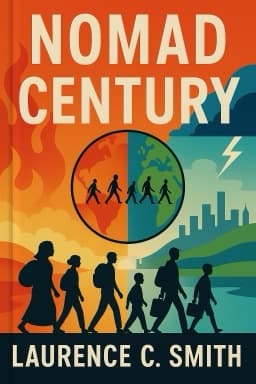
Ultimately, navigating the Nomad Century demands global cooperation and a reimagining of migration as a solution rather than a threat. Humanity’s history of mobility and adaptation equips us to meet these challenges if we embrace inclusive policies and collective action. The future depends on breaking down barriers, fostering understanding, and building resilient communities that reflect our shared home — Earth.
Want to explore more insights from this book?
Read the full book summary