
Unlocking Your Brain’s Hidden Power: How 'Nudge' Changes Everything About Decision Making
Discover the fascinating science behind your choices and how tiny nudges can transform your life.

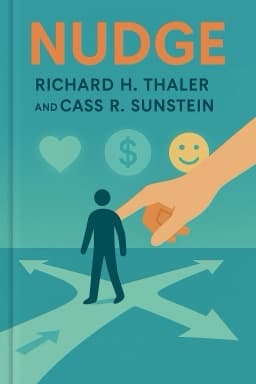
Every day, we make countless decisions—some trivial, others life-changing. Yet, have you ever wondered why despite our best intentions, we often fall prey to poor choices? The answer lies deep within the architecture of our minds. In their groundbreaking book Nudge, Richard Thaler and Cass Sunstein illuminate the invisible forces shaping our decisions and reveal how tiny, subtle nudges can guide us toward better outcomes without restricting freedom.
The authors introduce the concept of two cognitive systems: the Automatic System, which is fast, emotional, and instinctive, and the Reflective System, which is slow, deliberate, and analytical. This duality explains why we often act impulsively, favoring immediate gratification over long-term benefits. For example, when faced with a bowl of candy, the Automatic System urges us to indulge, while the Reflective System reminds us to stay healthy.
Understanding this internal tug-of-war is crucial. It sheds light on why self-control is so challenging and why external aids—like commitment devices or environmental design—can help us align our actions with our goals. Consider the ancient tale of Ulysses, who had himself tied to the mast to resist the Sirens’ song; this metaphor perfectly captures the power of precommitment to overcome temptation.
But nudging goes beyond individual willpower. Humans are innately social, deeply influenced by the behavior of others. Experiments reveal that people often conform to group opinions, even when they are clearly wrong, driven by a desire to fit in and avoid judgment. Campaigns that leverage social pride, such as the famous 'Don't Mess with Texas' anti-littering initiative, demonstrate how social norms can dramatically shift collective behavior.
Yet, not all choices are equally susceptible to error. The book highlights that decisions involving delayed benefits, complex information, or rare occurrences are particularly fraught. For instance, saving for retirement or choosing health insurance plans often overwhelm people’s cognitive resources, leading to suboptimal outcomes. Here, markets sometimes fail to protect consumers, exploiting confusion and inertia.
Nudges, then, become vital tools—smart defaults, clear incentives, timely feedback, and simplified options—that help overcome these challenges. Automatic enrollment in retirement plans, for example, boosts participation rates from 20% to over 90%, demonstrating the power of default settings without restricting freedom.
Health decisions also benefit from nudges. Countries adopting opt-out organ donation systems see dramatically higher donor rates, while simple cafeteria rearrangements that place fruits at eye level increase healthy eating by up to 25%. Medication adherence improves when patients receive timely reminders and clear instructions.
Ethically, nudges walk a fine line. The authors advocate for libertarian paternalism—a philosophy that nudges people toward better choices while preserving their freedom to choose otherwise. Transparency and easy opt-out options are essential to maintain trust and respect autonomy.
Looking ahead, nudges hold promise for transforming governance and personal empowerment. By designing environments that gently steer choices, society can improve health, wealth, and happiness at minimal cost and with broad bipartisan support.
In sum, Nudge offers a powerful framework to understand and improve human decision making. It invites us to be architects of our own choices and advocates for a world where freedom and well-being flourish together.
Ready to harness the power of nudges in your life? Stay tuned as we explore practical strategies and inspiring stories in the upcoming blogs.
Sources: Medium - The Art of Influencing Choices, Rare.org - On Nudging, EmbracePossibility.com - Nudge by Richard Thaler and Cass Sunstein, Nudges.wordpress.com 1 2 3 4
Want to explore more insights from this book?
Read the full book summary