
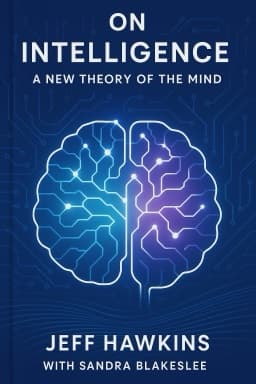
The Brain’s Memory-Prediction Framework: The Key to Consciousness and Creativity
How our brain’s predictive memory system gives rise to self-awareness and innovative thought.

Consciousness — our subjective experience of being — and creativity — the ability to generate novel ideas — are two of the most profound mysteries of the human mind. Traditional explanations often resort to abstract or metaphysical concepts. However, Jeff Hawkins’ 'On Intelligence' offers a grounded, scientific framework based on the brain’s memory-prediction system.
At its core, consciousness arises from declarative memory — the brain’s capacity to store and recall facts and experiences. This memory is not passive; it is actively engaged in predicting future inputs. Our awareness is shaped by this interplay of memory and prediction, allowing us to experience a continuous, coherent reality.
Creativity, often viewed as a mysterious spark, is explained as prediction by analogy. The brain combines existing memories in novel ways to anticipate new possibilities. This process underlies artistic inspiration, scientific discovery, and everyday problem-solving.
For example, a painter may blend familiar visual patterns to create a new style, while a scientist draws analogies from known phenomena to hypothesize about unknowns. These acts are manifestations of the brain’s predictive memory architecture at work.
Understanding consciousness and creativity through this lens demystifies them and highlights their continuity with basic brain functions. It also suggests that these phenomena are not exclusive to humans but exist along a spectrum in other intelligent beings.
Want to explore more insights from this book?
Read the full book summary