
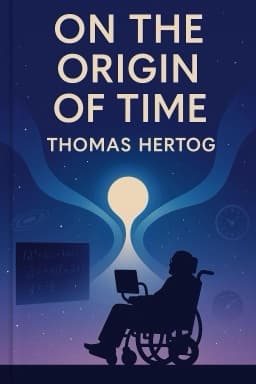
Is the Universe a Hologram? How Hawking’s Last Theory Turns Space and Time Upside Down
Explore the mind-bending holographic principle and its role in the quantum origin of the universe.

The holographic principle is one of the most profound ideas to emerge from the intersection of quantum mechanics and cosmology, and Stephen Hawking’s final theory embraces it fully. According to this principle, all the information contained within a volume of space can be represented as encoded data on its boundary surface. Imagine our three-dimensional universe as a projection from a two-dimensional holographic plate, much like a 3D image emerging from a flat surface.
This concept revolutionizes how we think about space, time, and reality itself. Quantum entanglement—the phenomenon where particles remain connected regardless of distance—plays a crucial role. Hawking’s theory suggests that the geometry of spacetime arises from the entanglement patterns of quantum bits (qubits) on the holographic boundary. In other words, the very fabric of our universe is woven from quantum information.
Perhaps most strikingly, time is not fundamental but an emergent property arising from these entanglement structures. This challenges the classical view of time as a universal, absolute dimension flowing steadily forward. Instead, time is born from the quantum relationships encoded holographically, reshaping our understanding of causality and the flow of events.
These ideas also provide elegant resolutions to longstanding cosmological puzzles. The no-boundary proposal, championed by Hawking, replaces the big bang singularity with a smooth, finite quantum state by introducing imaginary time. This transforms the universe’s origin into a boundary-less surface, akin to the surface of a sphere, avoiding infinite curvature and the breakdown of physics.
By combining the holographic principle with top-down cosmology, where the universe’s history emerges from present observations, Hawking’s theory offers a cohesive framework that integrates quantum mechanics, general relativity, and cosmology. It moves beyond speculative multiverse theories by grounding the universe’s properties in quantum informational processes.
For those intrigued by the mysteries of quantum gravity and the nature of time, Hawking’s last theory is a beacon of hope and insight. It invites us to reconsider our place in a universe that is not just vast and mysterious but fundamentally informational and participatory.
Leading science outlets and experts have explored these concepts in detail, providing accessible explanations and critiques. Notable discussions can be found in The Conversation and The Guardian, where the implications of the holographic universe and quantum cosmology are unpacked with clarity and depth. 1 2
Want to explore more insights from this book?
Read the full book summary