
Unlocking the Cosmos: Stephen Hawking’s Final Theory That Could Change Everything!
Dive deep into the revolutionary ideas that redefine our understanding of the universe’s origin and the nature of time.

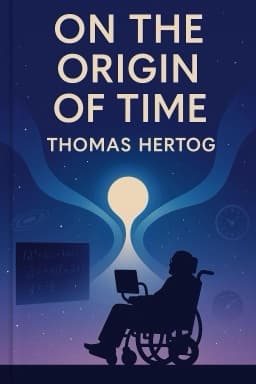
Stephen Hawking, one of the most brilliant minds in physics, left us with a final theory that challenges and expands our understanding of the universe’s deepest mysteries. Unlike traditional cosmological models that rely on classical physics and singularities, Hawking’s last work proposes that time and the laws of physics themselves are emergent phenomena arising from quantum foundations. This radical idea is explored in depth in the book On the Origin of Time, which synthesizes decades of Hawking’s insights into a coherent framework.
At the heart of this theory lies the concept of the universe’s fine-tuning. The cosmos appears to be exquisitely calibrated to support life, with physical constants like gravity’s strength, the cosmic microwave background fluctuations, and dark energy’s density set within narrow ranges. These 'cosmic coincidences' beg the question: why is the universe so hospitable? Hawking’s approach suggests that rather than being a mere accident or the product of a vast multiverse, the universe’s properties emerge naturally from quantum cosmology principles.
One of the most compelling aspects of the theory is the no-boundary proposal, which replaces the classical big bang singularity with a smooth, finite quantum state. By introducing the concept of imaginary time, the universe’s origin becomes like the surface of a sphere—finite but without edges or boundaries. This elegant solution removes the infinities that plagued earlier models and suggests a universe without a sharp beginning, where time itself is an emergent dimension.
The theory also embraces the holographic principle, which proposes that all information contained within a volume of space can be encoded on its boundary surface. This means our three-dimensional universe could be a projection from a two-dimensional quantum informational boundary. Quantum entanglement, the mysterious connection between particles, weaves together the fabric of spacetime and even gives rise to the dimension we perceive as time. This challenges classical notions and positions the observer as an integral part of the cosmic tapestry.
Moreover, Hawking’s top-down cosmology flips the traditional view of history. Instead of a fixed, unique past, multiple possible histories coexist in quantum superposition, and the actual past is selected retroactively based on present observations. This participatory universe concept places humanity not as passive observers but active participants in shaping reality, bridging science with philosophical reflections on freedom, alienation, and hope.
While the multiverse theory has captivated many, Hawking’s final theory offers a critical perspective, emphasizing the scientific challenges of testability and predictability in multiverse scenarios. Instead, the holographic and top-down frameworks restore scientific rigor and open paths to new discoveries.
In conclusion, Stephen Hawking’s final theory is not just a scientific model but a profound narrative that redefines our place in the cosmos. It invites us to embrace uncertainty, participate in the unfolding universe, and pursue knowledge as an ongoing journey. For anyone fascinated by the universe's mysteries, this theory offers a hopeful and inspiring vision of cosmic understanding.
For further insights, you may explore detailed analyses and reviews available from leading science communicators and physicists, such as Thomas Hertog’s interpretations and critiques in The Conversation, and accessible summaries in The Guardian and Forbes that highlight the revolutionary aspects of Hawking's work. 1 2 4
Want to explore more insights from this book?
Read the full book summary