
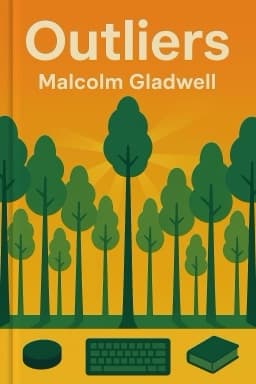
Why Your IQ Isn’t the Whole Story: The Hidden Power of Practical Intelligence
How social savvy and street smarts can trump raw IQ on the road to success.

We’ve all heard that intelligence quotient (IQ) is a key predictor of success. But Malcolm Gladwell’s Outliers challenges this notion by showing that IQ matters only up to a point. Beyond an IQ of about 120, additional intelligence yields diminishing returns in real-world achievement.
What makes the difference then? Gladwell introduces the idea of 'practical intelligence'—the ability to read situations, communicate effectively, negotiate, and advocate for oneself. This form of intelligence is often learned within family and cultural contexts that encourage questioning authority and developing social skills.
Research shows that children raised in environments promoting 'concerted cultivation'—where parents actively engage children in reasoning and negotiation—develop higher practical intelligence. These children grow up with a sense of entitlement that allows them to navigate institutions like schools, workplaces, and legal systems more effectively.
In contrast, children from families emphasizing 'natural growth' may be more deferential and less comfortable asserting themselves, which can limit practical intelligence despite high IQ.
This insight explains why some highly intelligent individuals struggle in social or professional settings, while others with average IQs excel by virtue of their social savvy. Practical intelligence helps people seize opportunities, build networks, and solve problems that IQ tests don’t measure.
Understanding this distinction encourages us to value and cultivate social skills alongside cognitive abilities. It also highlights the importance of family and cultural environments in shaping success.
For a deeper dive into how intelligence shapes achievement, Outliers offers compelling stories and research that challenge conventional wisdom.
References: Reading and Thinking, Bookish Insights, Blinkist Summary 2 , 1 , 4
Want to explore more insights from this book?
Read the full book summary