
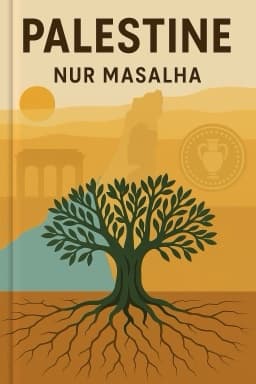
The Hidden History of Palestine: What You Didn’t Learn in School
Uncover the fascinating and often overlooked chapters of Palestine’s long history revealed by Nur Masalha.

History textbooks often reduce Palestine’s story to a brief account of 20th-century conflict, omitting thousands of years of cultural and political evolution. Nur Masalha’s 'Palestine: A Four Thousand Year History' offers a compelling alternative, illuminating the region’s rich past.
Did you know that the Philistines, often portrayed as foreign invaders, were likely indigenous to the southern Levant? Archaeological evidence reveals their deep integration with neighboring cultures. The classical period expanded the idea of Palestine beyond Philistia, with Greek and Roman historians documenting its diverse religious and cultural life.
Under Byzantine rule, Palestine was divided into three provinces that functioned as a unified political and religious entity, fostering centers of learning like the Rhetorical School of Gaza and the Library of Caesarea. Islamic conquest introduced Jund Filastin, a province that preserved Byzantine administrative systems while enhancing cultural pluralism.
The late Ottoman era saw the rise of Palestinian nationalism, expressed through literature, journalism, and traditional arts such as embroidery, which encoded regional identities. However, the British Mandate and Zionist settlement policies disrupted this continuity, culminating in the Nakba, which displaced hundreds of thousands and erased many place names.
Despite these hardships, Palestinians have maintained their identity through oral histories, cultural festivals, and the preservation of memory. This book is a vital resource for educators, students, and anyone curious about a fuller, richer understanding of Palestine’s past.
References: 2 , 3
Want to explore more insights from this book?
Read the full book summary