
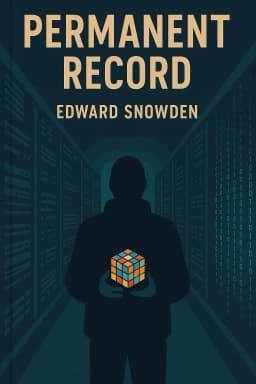
Inside the Mind of the World’s Most Famous Whistleblower: What Edward Snowden’s Memoir Reveals About Privacy and Power
A deep dive into the life, motivations, and revelations of Edward Snowden, the man who changed the global conversation on surveillance.

Few modern figures have shaped the discourse on privacy and government surveillance as profoundly as Edward Snowden. His memoir, Permanent Record, is not just a recounting of classified leaks but a deeply personal narrative that invites readers into the complex interplay of technology, ethics, and identity.
From his earliest days, Snowden was fascinated by the mechanics of technology. As a child, he demonstrated a playful curiosity—resetting clocks to extend bedtime and exploring the capabilities of his Commodore 64 computer, engaging with games like Arkanoid and Tetris. These early experiences were more than mere pastimes; they were the foundation of a lifelong quest to understand and master systems, a quest that would eventually lead him into the heart of the intelligence community.
Snowden’s family legacy, rich with military and intelligence service, instilled a strong sense of duty and patriotism. Yet, he grappled with the tension between inherited roles and personal conscience. The metaphor of the "invisible wall"—life’s unidirectional flow—reminds us that while we cannot change the past, we can choose how to move forward, embracing growth and ethical responsibility.
The post-9/11 landscape transformed intelligence agencies, ushering in an era where youthful technologists like Snowden revolutionized espionage. With unprecedented access to sensitive networks under diplomatic cover, these new agents built a digital surveillance apparatus capable of collecting and storing global communications indefinitely. The creation of resilient cloud architectures allowed agents worldwide to access and analyze data seamlessly, but this power came with profound ethical dilemmas.
Snowden’s decision to disclose classified information was a pivotal moment of moral awakening. Choosing to share documents exclusively with vetted journalists, he balanced transparency with responsibility, aware of the severe legal risks involved. This act challenged the notion that governments can operate without accountability and underscored the importance of whistleblowing as a form of civic duty.
The rise of mass surveillance has had a disproportionate impact on innocent people, infringing on fundamental human rights recognized globally. Snowden’s memoir urges us to reconsider the balance between state power and individual freedoms, highlighting the need for vigilance and public engagement in shaping democratic societies.
Further, the internet’s transformation from a space of pseudonymous creativity to a marketplace driven by surveillance capitalism reveals how corporate interests commodify personal data, eroding privacy and autonomy. Snowden’s reflections on the hacker’s ethic remind us that questioning and bending rules is a natural human impulse, a form of resistance against control.
Ultimately, Snowden’s story is about connection, truth, and the future. It challenges us to live lives grounded in love and belief, to speak truth to power, and to foster a world where technology serves humanity rather than dominates it. His memoir is both a cautionary tale and a call to action, inspiring us to protect our freedoms in an increasingly digital world.
By understanding Snowden’s journey, we gain insight into the ethical and technological challenges shaping our era. This memoir remains a vital resource for anyone seeking to comprehend the stakes of privacy, surveillance, and freedom today.
Want to explore more insights from this book?
Read the full book summary