
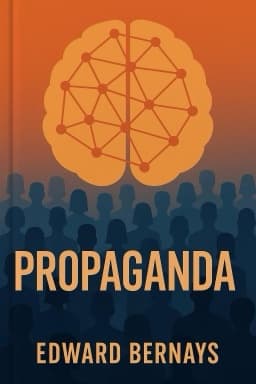
How Invisible Forces Shape Your Mind: The Untold Power of Propaganda
Discover the hidden mechanisms behind mass persuasion and how unseen leaders quietly guide society’s thoughts and behaviors.

Introduction: The Invisible Government
Have you ever wondered why you think the way you do, or why certain ideas suddenly become popular? Edward Bernays, often called the father of public relations, offers a profound insight in his book "Propaganda"—that a small, unseen group of leaders quietly governs public opinion. This 'invisible government' operates through social groups, media, and subtle psychological influences, guiding the masses without their awareness.
The Birth of Modern Propaganda
Propaganda, once a neutral term for spreading ideas, evolved dramatically with technological advances like the printing press, radio, and telegraph. These inventions allowed messages to reach millions instantly, creating unprecedented opportunities for influence. Bernays describes how propaganda became a science, using psychology and social science to craft messages that resonate emotionally and socially. For example, during wartime, coordinated media campaigns united populations behind national goals, illustrating propaganda’s power to mobilize.
The Architects of Influence: Public Relations Counsel
Behind every successful campaign is a public relations counsel who studies the client, analyzes public attitudes, and orchestrates media and events to shape perception. These professionals balance client interests with ethical standards, refusing dishonest clients to maintain credibility. A notable example is a soap company sponsoring nationwide art contests, engaging multiple social groups and embedding the product into cultural life.
The Psychology of the Masses
Groups do not think like individuals; they respond to emotions, impulses, and symbols. Clichés like 'Bolshevik' or 'interests' trigger strong reactions, mobilizing or intimidating populations. Associative influence links products or ideas with positive social status or emotions, such as a piano being desirable because it symbolizes refinement. This explains why propaganda often bypasses rational thought and appeals directly to unconscious desires.
Business and Public Relations
Businesses must sell not only products but also their reputation and policies. Mass production requires creating demand through advertising, fashion trends, and public relations. For example, a velvet manufacturer revived demand by influencing fashion leaders and organizing exhibitions, turning a trickle of interest into a flood of sales. Public goodwill, built through transparent practices and community engagement, is essential for long-term success.
Politics and Leadership
Political leaders use propaganda to lead public opinion, employing scientific voter analysis and targeted communication. Campaigns orchestrate rallies, media coverage, and emotional appeals to unify diverse populations. While powerful, this influence must be exercised ethically to preserve democratic integrity.
The Future of Propaganda
The future depends on ethics and public awareness. Public relations professionals increasingly adopt codes of honesty and social responsibility. The public grows more skeptical and media literate, demanding transparency and accountability. Ethical propaganda can become a force for education, cooperation, and social progress.
Conclusion
Propaganda is neither inherently good nor evil. Its impact depends on those who wield it and the values they uphold. By understanding its mechanisms, we can navigate the modern world with awareness and resilience, choosing consciously what to accept and how to participate in shaping society.
Sources: wisewords.blog, blinkist.com, wikipedia.org, thepowermoves.com 1 2 3 4
Want to explore more insights from this book?
Read the full book summary