
Unlocking the Secrets of Your Birth Date: The Surprising Science Behind Luck and Personality
Discover how your birth date quietly shapes your personality, luck, and even success in life — debunking myths and revealing science.

Have you ever wondered if the day you were born influences who you are? Beyond the horoscopes and zodiac signs, there is a growing body of scientific research exploring how birth dates subtly shape our personalities, luck, and even life outcomes. This field, known as chronopsychology, blends psychology and biology to uncover hidden patterns tied to our arrival in the world.
One of the most fascinating experiments involved a financial astrologer, a seasoned investor, and a random four-year-old child, each choosing stocks to invest £5,000. Over a turbulent year, the child's random picks surprisingly outperformed the experts, losing less money and even earning a small profit. This challenges the notion that star alignments or expert intuition can reliably predict financial success and highlights the powerful role of chance and skepticism in our lives.
But the influence of birth dates extends beyond money. In sports, a phenomenon called the 'relative age effect' shows that professional athletes are disproportionately born in the first months after their sport’s age cutoff date. This small age advantage translates into greater physical maturity and opportunities during crucial development periods, often snowballing into higher success rates. For example, English footballers born between September and November outnumber those born in June to August by two to one.
Even our sense of luck appears linked to the seasons. Studies indicate that people born in summer months tend to rate themselves as luckier and more sensation-seeking than those born in winter. Environmental factors like sunlight and temperature during early development may nudge personality traits that influence how we perceive and attract fortune.
Yet, humans are prone to illusions. The Barnum Effect explains why vague, flattering personality descriptions—like horoscopes—feel uniquely accurate. People accept these general statements because they satisfy a desire to be seen positively, rather than because of any true insight.
Understanding these scientific insights invites us to see beyond superstition and astrology, appreciating the subtle but real ways birth dates influence us. It empowers us to embrace our individuality grounded in evidence, not myth.
Ready to explore more fascinating quirks of human nature? Stay tuned as we delve into the art and science of deception, humor, and kindness in upcoming posts.
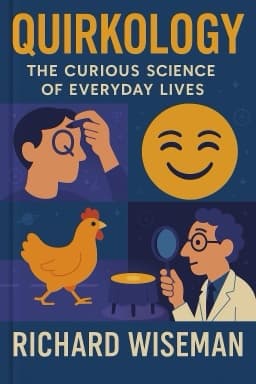
Sources: Blinkist summary of Quirkology, Customer Thermometer review, Goodreads insights, 5 Minute Book Summary 1 2 3 4
Want to explore more insights from this book?
Read the full book summary