
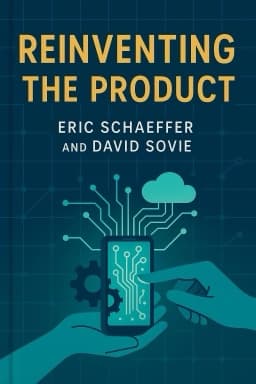
Unlocking the Future: How 'Reinventing the Product' Will Change Your Business Forever
Discover the groundbreaking strategies that turn traditional products into intelligent, connected experiences that customers crave.

In today’s rapidly evolving marketplace, the old rules of product development and business strategy no longer apply. The book Reinventing the Product provides an essential blueprint for companies caught in the whirlwind of digital transformation. It challenges the traditional notion that products are merely physical objects, highlighting how software, connectivity, and data have become the heart of product value.
The book opens by outlining six digital imperatives that every company must embrace: transforming the core business, focusing relentlessly on customer experience, building or joining ecosystems, innovating new business models, cultivating digital talent, and managing multiple pivots simultaneously. These imperatives are not just buzzwords; they are practical guides for survival and growth in a world where disruption is the norm.
One of the most powerful insights is the shift from outputs to outcomes — companies must move beyond selling products to delivering measurable results and personalized experiences. This is exemplified by companies that embed sensors and AI into their products, turning tires, vehicles, or industrial equipment into continuous service platforms.
The Product Reinvention Grid framework helps companies map their journey along two critical dimensions: Intelligence Quotient (IQ) and Experience Quotient (EQ). This model serves as a compass, guiding investment decisions and innovation priorities. Products evolve from static, feature-heavy objects to intelligent, adaptive, and experience-rich platforms that learn and improve over time.
AI emerges as the intellectual bedrock of this transformation. With capabilities such as machine learning, natural language processing, and autonomous decision-making, AI enables products to sense, understand, and act — creating truly intelligent companions rather than passive tools.
But technology alone is not enough. The book stresses the importance of agile engineering and continuous innovation. Digital twins and threads allow virtual testing and real-time monitoring, enabling companies to iterate rapidly and reduce time to market from years to months.
Moreover, the rise of platforms and ecosystems represents a fundamental shift in value creation. Platforms harness network effects, enabling partners to co-create and deliver integrated solutions, often disrupting traditional industry boundaries.
Finally, the book identifies seven pivotal capabilities companies must develop — from design flexagility to pervasive security — and lays out a detailed roadmap for transformation, emphasizing the need for clear vision, skilled workforce, and early pivots.
Embrace this journey, and your business will not only survive but flourish in the new economy.
— Sources: Amazon, Kogan Page, Skillsoft 1 2 3
Want to explore more insights from this book?
Read the full book summary