
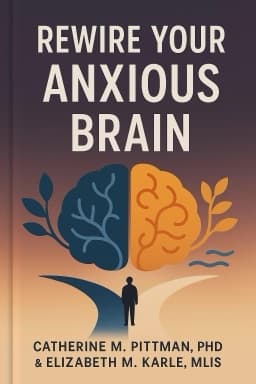
Unlocking the Secrets of Your Anxious Brain: 7 Neuroscience Hacks for Lasting Calm
Discover How Understanding Your Brain Can Transform Your Anxiety—For Good!

Discover How Understanding Your Brain Can Transform Your Anxiety—For Good!
Imagine waking up each morning with a sense of possibility, not dread. For millions, anxiety is a constant companion, but what if the key to freedom lies not in fighting your feelings, but in understanding the remarkable organ behind them—your brain? In 'Rewire Your Anxious Brain,' Catherine M. Pittman and Elizabeth Karle peel back the layers of neuroscience, showing us that anxiety is not a personal flaw, but a pattern in our brain’s wiring, one that can be changed at any age.
Let’s start with a journey deep inside your mind. Picture two highways: one ancient, fast, and emotional—the amygdala pathway; the other thoughtful, analytical, and sometimes worry-prone—the cortex pathway. The amygdala is your brain’s alarm system, reacting to perceived danger in milliseconds. It’s why you might jump at a loud noise or feel panic in a crowded elevator. The cortex, on the other hand, is where thoughts swirl, worries grow, and what-ifs multiply. It’s the voice that keeps you awake at night, replaying conversations or predicting disasters.
Understanding which pathway your anxiety travels is the first hack to lasting calm. If your anxiety is sudden and physical—racing heart, sweaty palms, the urge to escape—it’s likely your amygdala at work. If it’s a slow build of thoughts, worries, and mental loops, your cortex is in the driver’s seat. Most people experience both, and the two often create a feedback loop that can feel overwhelming.
But here’s the breakthrough: neuroplasticity. Your brain is not fixed. Every new experience, every moment of calm, every act of courage literally rewires your neural pathways. This means that with practice, you can teach your brain new ways to respond to old triggers. The book is filled with inspiring stories—people who faced lifelong fears, only to find, through gentle exposure and daily practice, that their brains could learn to feel safe again.
So what are the seven hacks? First, learn the language of your amygdala: it responds to experience, not logic. Gentle, repeated exposure to triggers—like gradually spending time in anxiety-provoking situations—teaches your amygdala to stand down. Second, train your cortex with thought-defusion: notice your thoughts, label them as just thoughts, and let them drift by. Third, practice deep breathing and progressive muscle relaxation. These skills send calming signals to your amygdala, breaking the cycle of panic.
Fourth, build resilience through daily habits: exercise, sleep, and routine support brain health and make change easier. Fifth, track your progress with a journal—celebrating victories and learning from setbacks. Sixth, set small, achievable goals and celebrate each win, no matter how minor. Seventh, practice self-compassion. Treat yourself with the kindness you’d offer a friend; research shows this alone can reduce anxiety and speed healing.
Perhaps most importantly, remember that you are not alone. Community, support groups, and shared stories multiply the power of every step you take. As you practice these neuroscience-based strategies, you’ll find that anxiety is no longer the ruler of your life, but a passing cloud in a sky that grows brighter every day.
With each new day, you have the power to rewire your anxious brain. The journey is gentle, hopeful, and—most of all—possible for everyone. Ready to begin?
Want to explore more insights from this book?
Read the full book summary