
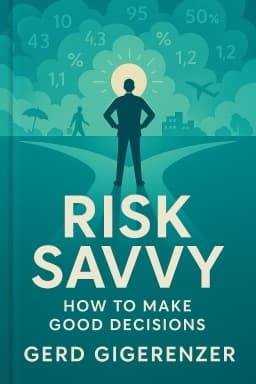
Why You’re Probably Making Risky Decisions Without Even Knowing It
Discover the Hidden Pitfalls in Your Daily Choices and How to Outsmart Them
Discover the Hidden Pitfalls in Your Daily Choices and How to Outsmart Them
Every day, we face a barrage of choices, each carrying its own risks and rewards. Yet, most of us are blissfully unaware of how poorly we judge these risks. Consider this: after 9/11, many Americans avoided flying, turning instead to driving—an act that led to thousands of additional road deaths. Why? Because our brains are hardwired to dread spectacular, rare events, even when the real danger lies elsewhere. This is just one example of how risk illiteracy shapes our world.
Our misunderstanding of risk isn’t just about airplanes and terror. It seeps into health, finance, and even the weather forecast. When told there’s a 30% chance of rain, people interpret it in wildly different ways—some think it will rain for 30% of the day, others that it will rain in 30% of the area. The truth? It means that in similar conditions, it rains three out of ten times. This confusion is more than a curiosity; it leads to bad decisions, wasted money, and even unnecessary panic.
Media headlines often stoke our fears by quoting relative risks, not absolute ones. A headline might scream, ‘New Pill Doubles Risk of Blood Clots!’—but if the risk goes from 1 in 7,000 to 2 in 7,000, the absolute danger remains tiny. Without understanding the difference, people make choices that harm rather than help.
So why are we so bad at risk? Partly, it’s biology: evolution primed us to fear snakes and spiders, not cars or electricity. But it’s also culture. In Germany, people fear nuclear power; in the US, it’s guns; in France, a liver diagnosis brings comfort. These fears are learned, passed down like family recipes, often with little basis in reality.
But there’s hope. Risk literacy isn’t about memorizing statistics—it’s about asking the right questions. What does this risk mean for me? How was it measured? What’s the absolute chance? By using simple visual tools and real-life examples, anyone can become more risk savvy.
In the end, embracing uncertainty is not about eliminating fear, but understanding it. The more we know, the less we panic—and the better our lives become. Are you ready to see the world with clearer eyes?
Want to explore more insights from this book?
Read the full book summary