
Unlocking the Hidden Laws of Life and Cities: How Scale Shapes Our World
Discover the surprising universal rules that govern everything from the beating of your heart to the growth of megacities.

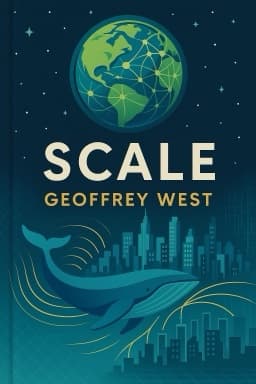
Have you ever wondered why a mouse’s heart beats faster than an elephant’s, or why cities grow faster than companies but never seem to die? The answers lie in the fascinating world of scaling laws — hidden mathematical relationships that govern the size, growth, and function of complex systems. Geoffrey West's groundbreaking book 'Scale' opens a window into this mysterious order, revealing that beneath the apparent chaos of biology, urban life, and economics, there is a surprising simplicity.
At the heart of this discovery is the realization that many quantities do not scale linearly with size. For example, the metabolic rate of mammals scales to the three-quarters power of their body mass, meaning larger animals use energy more efficiently per unit mass. This counterintuitive fact explains why elephants live longer and have slower heartbeats compared to tiny mice, which race through their lives with rapid pulses.
Moving beyond biology, West explores cities as 'superorganisms' — complex adaptive systems that exhibit their own unique scaling laws. Unlike companies or organisms, cities grow superlinearly in terms of innovation, wages, and even crime. This means that doubling a city's population results in more than double the number of patents produced or economic output. Yet, infrastructure such as roads and pipes scales sublinearly, so larger cities become more efficient per capita in resource use.
Companies, however, tell a different story. They grow rapidly but face mortality at a surprisingly constant rate, with many disappearing within a decade regardless of size. Their growth is sublinear, constrained by bureaucratic overhead and market forces. This contrasts sharply with cities' open-ended growth and resilience, highlighting the importance of social and infrastructural networks in sustaining complex systems.
West’s insights extend beyond academic curiosity — they offer vital clues to our collective future. As urban populations soar and innovation accelerates, understanding these scaling laws can guide sustainable development, economic policy, and environmental stewardship. The accelerating treadmill of innovation demands new paradigms that balance growth with planetary limits.
In summary, 'Scale' reveals a hidden order that unites life, cities, and economies under universal laws. Embracing this knowledge empowers us to navigate complexity with wisdom and hope. As we face unprecedented global challenges, the science of scale lights a path toward a sustainable, innovative future.
For those fascinated by the interplay of biology, urbanism, and economics, this exploration of scale offers both profound insights and practical implications. Dive in and discover the rhythms that shape our world.
Want to explore more insights from this book?
Read the full book summary